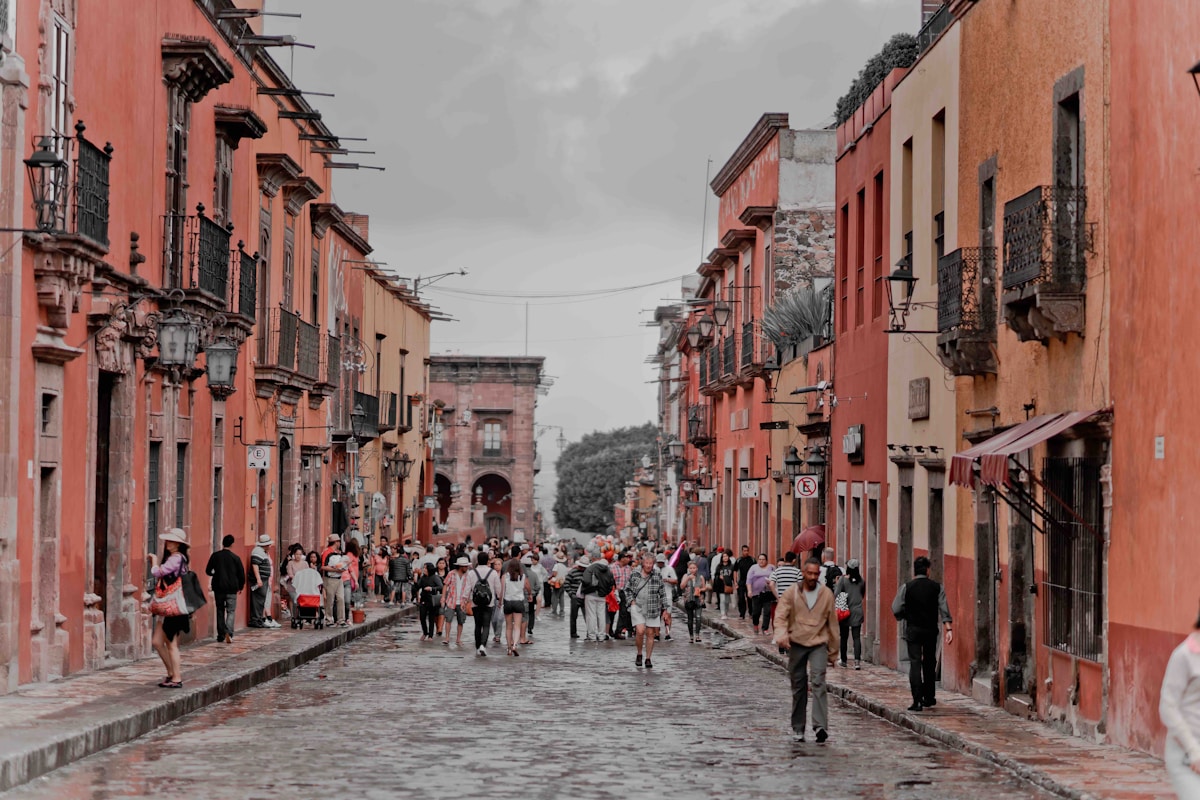
San Miguel de Allende Travel Guide
San Miguel de Allende guide: colonial architecture, the Parroquia de San Miguel, art galleries, cooking schools, and the expat community.
Guides for San Miguel de Allende
San Miguel de Allende is a UNESCO World Heritage colonial city in the high desert of Guanajuato state, at 1,910 m elevation. It has one of the highest concentrations of art galleries, cooking schools, and luxury boutique hotels of any small city in Mexico - and a large English-speaking expat community that has shaped both the character and the prices. It is expensive by Mexican standards, but the architecture is genuinely exceptional.
Key sights
| Sight | Entry Fee | Hours | Notes |
|---|---|---|---|
| Parroquia de San Miguel Arcángel | Free | Daily 6:00–20:00 | Neo-Gothic church, city’s defining landmark |
| Instituto Allende | Free (campus) | Mon–Fri 9:00–18:00 | 18th-century art school in a converted hacienda |
| Fabrica La Aurora | Free | Mon–Sat 10:00–18:00 | Former textile mill, galleries and design studios |
| Jardín Botánico El Charco | ~MXN $50 | Daily 8:00–18:00 | Desert botanical garden, canyon walks |
| La Gruta hot springs | ~MXN $350 | Wed–Sun 8:00–18:00 | Thermal pools inside a cave, 10 km from town |
| Escondido Place | ~MXN $300 | Daily 9:00–18:00 | Multiple hot spring pools, varied temperatures |
All prices approximate, as of 2026.
The Parroquia and the centre
The Parroquia de San Miguel Arcángel - the neo-Gothic church at the heart of town - is the city’s defining image. It was redesigned in the late 19th century by Zeferino Gutiérrez, a self-taught indigenous mason who based the design on postcards of European Gothic churches. The result is eccentric and striking. The Jardín Principal (main square) in front of it is the social centre of the city, shaded by laurel trees and surrounded by restaurants and cafés.
The streets radiating from the square - Umaran, Canal, Correo, Sollano - are lined with the best-preserved colonial buildings, painted in terracotta, ochre, pink, and burnt orange, with wrought-iron balconies and heavy wooden doors.
Art and culture
San Miguel has been an artists’ colony since the mid-20th century, when foreign painters discovered the colonial setting and the Instituto Allende fine arts school. Today the city has more galleries per capita than any comparable city in Mexico.
Fabrica La Aurora - a former textile mill north of the centre, now housing the city’s largest concentration of galleries and design studios in a repurposed industrial space. Free to enter, open Monday–Saturday. Quality ranges from tourist-facing to serious contemporary art.
First Friday gallery walks happen monthly (November–May) - dozens of galleries open simultaneously along Calle Zacateros and surrounding streets, often with wine and live music. Free.
Centro Cultural Ignacio Ramírez (El Nigromante) - former convent, now an art centre with murals by David Alfaro Siqueiros. Free entry. The courtyard has rotating exhibitions.
Where to stay
| Zone | Budget | Mid-range | Luxury |
|---|---|---|---|
| Centro Histórico | Hostels from ~MXN $300/night | Hotels from ~MXN $1,200/night | Boutique from ~MXN $4,000/night |
| Near Parque Juárez | Limited | B&Bs from ~MXN $1,000/night | From ~MXN $3,500/night |
Named properties: Hostal Alcatraz (dorms from approximately MXN $300/night, courtyard). Hotel Posada de las Monjas (mid-range, from approximately MXN $1,500/night, central location, rooftop terrace). Casa 1810 (boutique, from approximately MXN $3,000/night, colonial courtyard). Hotel Matilda (design hotel, from approximately MXN $5,000/night, spa, rooftop pool). Rosewood San Miguel (from approximately MXN $10,000/night, the most luxurious property in the city).
San Miguel is expensive - budget travellers are better served by nearby Guanajuato city, which has similar colonial charm at lower prices.
For the full range of hotels and guesthouses, search all hotels in San Miguel de Allende on Booking.com →.
Food
The restaurant scene is sophisticated and expensive relative to the rest of Mexico. For high-end dining, Áperi (inside Hotel Matilda, tasting menus from approximately MXN $1,500), Trazo 1810 (modern Mexican, mains approximately MXN $250–450), and Bovine (steakhouse, mains approximately MXN $300–500) are consistently well-regarded.
For something more affordable, the Mercado Ignacio Ramírez (covered market on Colegio) has a food section with comida corrida from approximately MXN $70–100. The Tuesday tianguis (street market) near Calzada de la Luz has the best carnitas stands and market food.
Cooking classes are a major draw - several schools run half-day classes in regional Bajío cuisine, including a market visit, hands-on cooking, and a meal. From approximately MXN $1,500–3,000 per person.
Hot springs
La Gruta - 10 km south of town, the most atmospheric option. Natural thermal pools inside a cave - the steaming rock chambers are dramatic. Entry approximately MXN $350. Closed Mondays and Tuesdays. Taxi from the centre approximately MXN $150 (20 minutes).
Escondido Place - 15 km from town, with more varied pools at different temperatures and a quieter atmosphere. Entry approximately MXN $300.
Both are popular with the expat community on weekends - weekday visits are considerably quieter.
Day trips
Dolores Hidalgo (45 km northeast, 45 minutes) - birthplace of Father Hidalgo and the starting point of Mexican Independence. The Parroquia de Nuestra Señora de los Dolores is where the Grito was first issued on 16 September 1810. The town is also famous for nieve de garrafa - unusual ice cream flavours including tequila, shrimp, and nopal cactus. Approximately MXN $30–50 per cone. Buses from San Miguel approximately MXN $50.
Guanajuato City (95 km west, 1.5 hours) - one of Mexico’s most visually dramatic cities, with coloured buildings stacked in a ravine and an underground road network. A full-day excursion or overnight trip. Buses approximately MXN $100–150 each way.
Getting there and around
Nearest airport: Bajío International Airport (BJX), 100 km west (shared shuttle approximately MXN $400–500, taxi approximately MXN $1,500). Mexico City airport is 4 hours by bus (first-class ETN/Primera Plus approximately MXN $500–700).
Within the city: The historic centre is compact and walkable - 20 minutes end to end. The cobblestone streets are steep in places. Taxis and Uber operate within the city. Driving in the centre is possible but parking is difficult and not recommended.
When to go
The climate is mild year-round at 1,910 m elevation - warm days (22–28°C), cool nights (5–12°C). December–January is the most atmospheric, with elaborate Christmas and Día de Reyes celebrations. The International Chamber Music Festival in August is one of the city’s major annual events. Semana Santa (Holy Week) draws large crowds and higher prices.
More San Miguel de Allende Guides
- Day Trips in San Miguel de Allende
- Food to Try in San Miguel de Allende
- Things to Do in San Miguel de Allende
- Where to Stay in San Miguel de Allende
- Best Tours in San Miguel de Allende - balloon rides, tequila tastings and colonial art tours
Comparison Guides
Plan your trip: tours in San Miguel de Allende · hotels in San Miguel de Allende · flights to Mexico · travel insurance · eSIM for Mexico.
See Also
- Guanajuato Travel Guide - 1.5 hours west, the university city most frequently compared with SMA
- Morelia Travel Guide - 3 hours south, another Michoacán colonial city on the same highland circuit
- Pueblos Mágicos - Mexico’s heritage town programme
- Honeymoon Guide to Mexico - San Miguel is one of Mexico’s top honeymoon destinations
- Solo Travel in Mexico - SMA’s compact walkable centre and expat community make it very solo-friendly
Book an experience
Top experiences in San Miguel de Allende
Explore the best tours and activities in San Miguel de Allende, with instant confirmation and free cancellation on most bookings.
Find hotels in San Miguel de Allende
Compare rates and availability across hundreds of options, free cancellation on most.
Browse hotels in San Miguel de Allende →Affiliate link; commission earned at no cost to you.