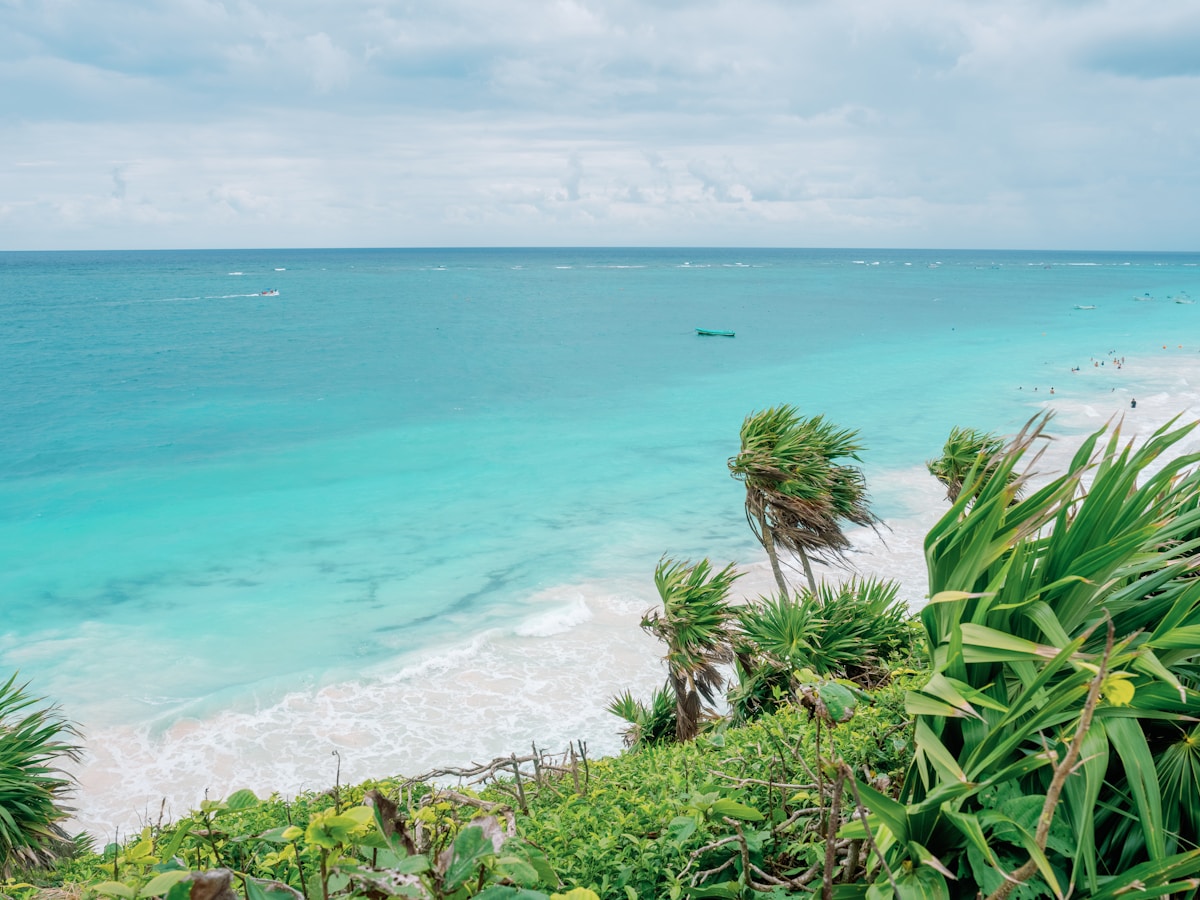
The Riviera Maya stretches 130 km from Cancún south to Tulum along Mexico’s Caribbean coast. The water is warm year-round (26–29°C), calm on most beaches, and the colour of blue-green glass. The sand is white limestone powder that stays cool underfoot. The variance between specific beaches is significant, however - between overcrowded resort strips, pristine island shorelines, and hidden coves accessible only by boat, choosing well makes a real difference to the experience.
Cancún
Playa Delfines
The best free public beach in the Cancún Hotel Zone. Wide, uncrowded compared to the resort-front beaches, with open ocean exposure that creates moderate wave action - good for atmosphere and body surfing, less ideal for small children. Free parking (the only free lot in the Hotel Zone). The “CANCÚN” sign here is one of the most photographed landmarks in Mexico. No beach club infrastructure - bring your own shade and drinks, or buy from vendors.
Playa Tortugas
In the northern Hotel Zone, smaller and more sheltered than Delfines. Calmer water suitable for children. Public access with beach chairs available (approximately MXN $100–200 with food purchase from adjacent restaurants). The ferry to Isla Mujeres departs from the pier here (approximately MXN $300 return, 20 minutes).
Playa Forum (Playa Gaviota Azul)
Adjacent to the nightlife zone - the liveliest beach in the Hotel Zone. Beach clubs (Mandala Beach Club, The City Beach Club) charge entry or require minimum consumption (approximately MXN $300–500). Young, party-focused atmosphere. Not the place for a quiet beach day.
Playa Caracol
Near the convention centre, a smaller beach with calmer water in a more protected section of the lagoon side. Good for swimming. Less crowded than Delfines.
Isla Mujeres
Playa Norte
Consistently ranked one of the best beaches in the Caribbean and the finest beach accessible from Cancún. The sand is powdery white, the water is turquoise and stays shallow and calm far from shore - you can wade out 50+ metres at waist depth. Beach bars line the shore (Poc-Na, Buho’s) with beach chairs and drink service. The sunset views facing back toward Cancún are excellent.
Getting there: Ultramar ferries from Puerto Juárez (approximately MXN $300 return) or from Playa Tortugas (approximately MXN $350 return). Journey 15–20 minutes. Ferries run every 30 minutes from approximately 5:30 am to 11:30 pm.
Day trip or overnight: Day-trippable from Cancún, but staying overnight (budget hotels in the town from approximately MXN $800/night) gives you the beach in the early morning and evening without the day-tripper crowds. The town has good restaurants - Ruben’s (fish tacos, approximately MXN $80–150), Lola Valentina (seafood, approximately MXN $150–300).
Playa del Carmen
Playa Norte (north of Constituyentes)
North of Avenida Constituyentes, the beach becomes noticeably calmer, wider, and less crowded than the central Hotel Zone section. Good swimming, moderate beach club presence. The further north you walk, the quieter it gets. Some sections are affected by sargassum seasonally.
Central beach (Quinta Avenida area)
The beach directly east of Quinta Avenida and the ferry terminal. Convenient but narrow in places, crowded during peak season, and heavily commercialised with beach club chairs. Swimming is fine - the water is calm and clear.
Playacar beach
South of the centre, fronting the Playacar resort complex. Wide, well-maintained (resorts clear sargassum mechanically), calm swimming. Public access is available at the south end of Playa del Carmen’s beach - walk past the ferry terminal heading south. The beach is technically public, though the resort infrastructure can feel unwelcoming to non-guests.
Tulum
Playa Paraíso
Below the cliff where the Tulum ruins sit. The combination of ancient towers visible from the beach and the jade-green water makes this one of the most photogenic beaches in Mexico. The sand is fine and white, the water is warm and swimmable.
The reality: It gets very crowded by 10 am, particularly during December–April high season. Beach clubs manage most of the chair access (approximately MXN $200–500 for a chair with minimum consumption). For the best experience, arrive at 8 am. Access is from the path that descends from the ruins (buy a ruins ticket, approximately MXN $100, or use the public beach access south of the archaeological zone).
Playa Ruinas
Slightly north of Paraíso, with a different angle on the ruins. Beach access has been increasingly commercialised - a beach club manages the area. The beach itself is narrower than Paraíso but less crowded because of the controlled access.
Beach strip south of Tulum
The hotel zone stretching south along the Carretera Tulum–Boca Paila road has beautiful beaches fronting eco-lodges and boutique hotels. Most are technically public (all Mexican beaches are federal property), but access through hotel properties can be restricted in practice. The stretches between hotels are the most accessible - look for public access paths from the road. The further south you go, the quieter the beach becomes.
Akumal
A bay approximately 35 km south of Playa del Carmen, famous for sea turtles that feed on the seagrass beds close to shore. Snorkelling with turtles is the main draw - guided snorkelling tours are required (approximately MXN $500–800 per person, 1–1.5 hours) as of recent regulations to protect the turtle population. Independent snorkelling in the main bay is restricted during peak hours.
The beach itself is pleasant - calm, shallow, with good sand. Half Moon Bay (Bahía de la Media Luna), a 10-minute walk north, is quieter and has good snorkelling without the turtle crowd restrictions.
Getting there: Colectivos from Playa del Carmen (approximately MXN $40, 25 minutes) drop off at the highway turnoff; it is a 10-minute walk to the beach from the highway.
Cozumel
Mexico’s largest Caribbean island, approximately 20 km offshore from Playa del Carmen. The western (leeward) side has calm water and the island’s best beaches; the eastern (windward) side has dramatic waves and dangerous currents.
Playa Palancar: On the southwest coast - a long, quiet stretch of white sand with calm turquoise water. Minimal development, one or two beach restaurants. Accessible by car, scooter, or taxi from San Miguel town (approximately 20 km, MXN $250–350 by taxi).
Playa El Cielo: A shallow sandbar off the southern tip accessible by boat - famous for starfish on the sandy bottom. Boat tours from the main pier (approximately MXN $800–1,200 per person) include snorkelling stops at nearby reefs.
Cozumel’s reefs: The real attraction is underwater - Cozumel’s Palancar and Colombia reef systems are among the best diving in the Caribbean. Two-tank dive trips cost approximately MXN $1,800–2,500 with certified operators. Snorkelling from the beach is also excellent at Playa Corona and Money Bar Beach.
Getting there: Ferries from Playa del Carmen’s main pier (Ultramar and Winjet, approximately MXN $350–450 return, 45 minutes). Ferries run every 1–2 hours.
Holbox island
On the north coast of the Yucatán Peninsula, where the Gulf of Mexico meets the Caribbean. Not technically on the Riviera Maya, but accessible from Cancún and increasingly popular.
The north shore beach is not Caribbean in the conventional sense - the water is shallower and greener (the Gulf/Caribbean confluence), and the sand bar extends far out. But the white sand, palm trees, and lack of development create a distinctive atmosphere. No cars on the island - transport is by golf cart (rental approximately MXN $500–800/day).
Getting there: ADO bus from Cancún to Chiquilá (approximately MXN $200–250, 2.5 hours), then ferry to Holbox (approximately MXN $200, 25 minutes). Combined transfer services from Cancún are available (approximately MXN $600–800 per person).
Best for: Whale shark season (June–September, approximately MXN $2,500–3,500 per person for a snorkelling trip), bioluminescence (seasonal, best viewed July–December), and a genuinely quiet island pace.
Sargassum seaweed
Sargassum (brown seaweed) has accumulated on Caribbean beaches annually since approximately 2015 and affects the Riviera Maya significantly during May–September in most years. It clumps on the beach and decomposes, releasing hydrogen sulphide (a rotten-egg smell). The impact varies dramatically year to year and beach to beach:
- Worst affected: Open-coast beaches from Cancún to Tulum. South-facing beaches often receive the heaviest deposits
- Less affected: Isla Mujeres (Playa Norte is somewhat sheltered), Cozumel (western side), Holbox (Gulf-facing)
- Resort response: High-end resorts clear sargassum mechanically from their frontages using tractors and barriers. Public beaches may be heavily affected
- Real-time information: Instagram location searches and recent Google Maps photos give the most current picture. The website SargassoMonitor.com tracks satellite data
During bad sargassum periods (which can last weeks), beach quality drops significantly. If travelling May–September, have backup plans - cenotes, pools, and the western coast of Cozumel are reliable alternatives.
Beyond the hotel zones
The best beaches away from the resort strips require effort but reward it:
- By water taxi from Cozumel: Playa El Cielo sandbar (starfish, snorkelling)
- By boat from Puerto Morelos: reef snorkelling trips to the barrier reef (approximately MXN $800–1,200, 2–3 hours) - Puerto Morelos sits directly on the Mesoamerican Barrier Reef, the second-largest in the world
- Highway 307 turnoffs: Between Playa del Carmen and Tulum, unmarked turnoffs lead to beach stretches attached to smaller eco-parks and cenote operations with far fewer visitors than the main beaches
- Sian Ka’an Biosphere Reserve: South of Tulum, a UNESCO-protected reserve with pristine beaches accessible by boat tour from Tulum or by 4WD on the unpaved road. Day tours approximately MXN $1,500–2,500 per person. The floating canal tour through the mangroves is unique to this area
Search hotels in Riviera Maya on Booking.com
Practical notes
- Beach access rights: All beaches in Mexico are federal property (zona federal marítimo-terrestre) - legally public to the waterline. Resort and hotel properties cannot legally prevent beach access, though they can restrict access through their property. Public access paths exist in most areas
- Water safety: The Caribbean side is generally calm, but some beaches (eastern Cozumel, exposed areas south of Tulum) can have strong currents. Swim at lifeguarded beaches where possible
- Sun protection: UV intensity is high year-round at this latitude. Reef-safe (biodegradable) sunscreen is required in eco-parks and increasingly at public beaches
- Cenote alternative: When beach conditions are poor (sargassum, rain, wind), the cenotes along the Riviera Maya offer crystal-clear freshwater swimming. Gran Cenote (approximately MXN $500), Cenote Dos Ojos (approximately MXN $400), and Cenote Azul (approximately MXN $150) are the most popular and all within 30 minutes of Tulum
Plan your trip: tours across Mexico · travel insurance · flights to Mexico.