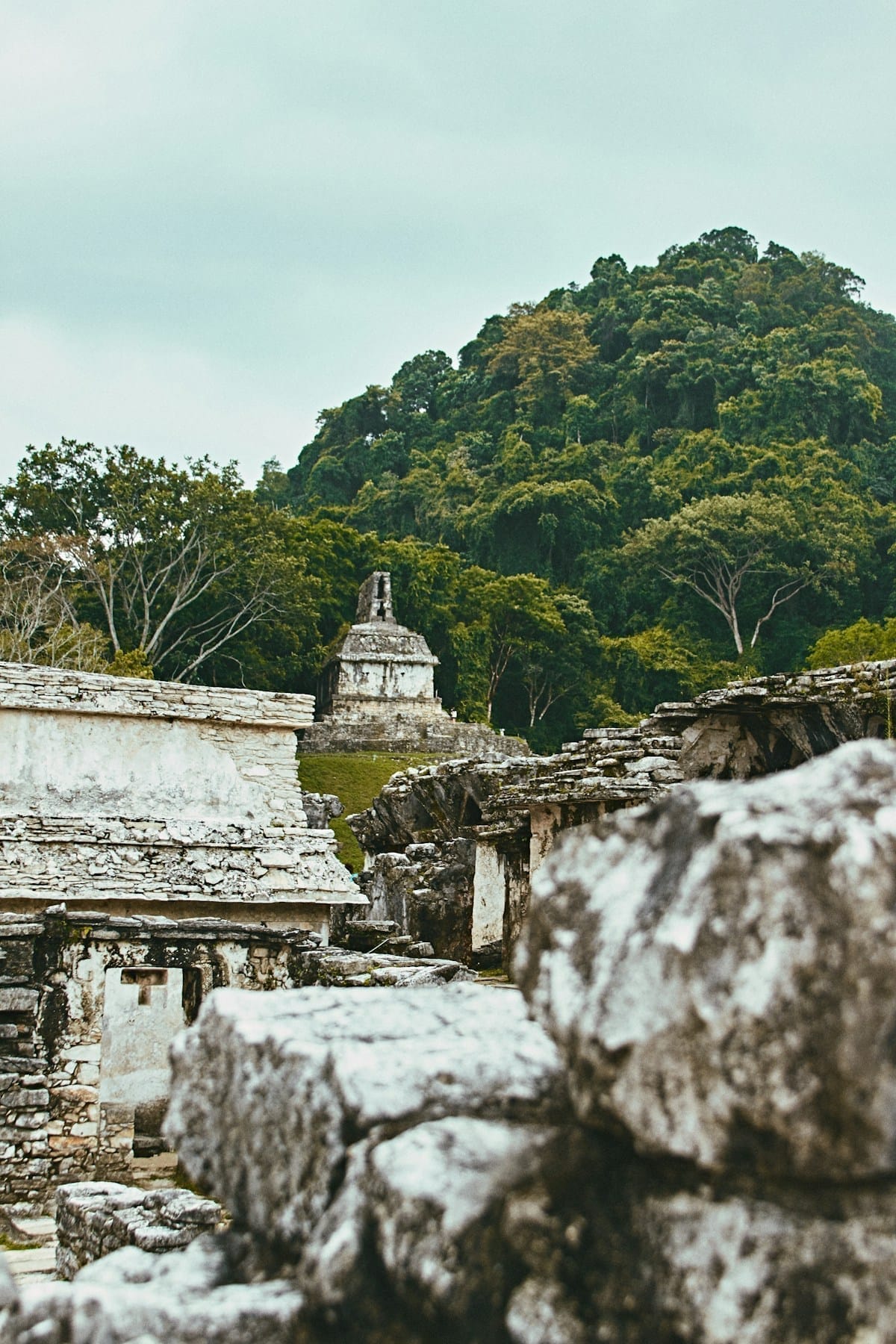
Palenque itself is one of Mexico’s finest Maya sites, but the Chiapas lowlands around it hold an unusual concentration of secondary attractions within striking distance: jungle waterfalls, remote Maya sites with surviving murals, and one of the most dramatic highland mountain drives in southern Mexico. The surrounding landscape - dense tropical rainforest at 60 m elevation - is alive with howler monkeys, toucans, and macaws.
Top Tours at a Glance
Here’s a quick comparison of top-rated guided tours on GetYourGuide:
| Tour | Duration | Price (from) | Group Size | Highlights |
|---|---|---|---|---|
| Yaxchilán Ruins Day Trip by Boat | Full day | from $120/person | Small group | River crossing to remote Usumacinta ruins, guide |
| Bonampak Murals Day Trip | Full day | from $130/person | Small group | Intact pre-Columbian murals, jungle drive, guide |
| Agua Azul Waterfalls + Misol-Ha Half Day | Half day | from $30/person | Group | Turquoise pools, Misol-Ha jungle waterfall |
| San Cristóbal de las Casas Day Trip via Scenic Route | Full day | from $65/person | Group | Chiapas highlands, indigenous markets, waterfalls |
Browse all Palenque tours → GetYourGuide
Quick comparison
| Day Trip | Distance | Transport | Entry | Time Needed |
|---|---|---|---|---|
| Misol-Ha waterfall | 20 km south | Combi ~MXN $40 | ~MXN $30 | 1–2 hours |
| Agua Azul cascades | 61 km south | Combi ~MXN $70 | ~MXN $80 | Half–full day |
| Tonina ruins | 120 km south | Car ~2 hrs | ~MXN $90 | Half day |
| Yaxchilán ruins | 160 km southeast | Car + boat | ~MXN $100 | Full day |
| Bonampak murals | 145 km southeast | Car ~3.5 hrs | ~MXN $100 | Full day |
| San Cristóbal | 210 km west | Bus ~5 hrs | Free (city) | Full day (or overnight) |
All costs approximate, as of 2026.
Misol-Ha - 20 km south, 30 minutes
The easiest and most rewarding short trip from Palenque. Misol-Ha is a single 35 m waterfall plunging from a jungle overhang into a wide circular pool - and unusually for a major waterfall, you can walk behind it. A concrete path loops around the pool and through a cave behind the falls; at peak flow the waterfall is wide enough to create a curtain of mist and sound that is genuinely overwhelming.
Entry approximately MXN $30 as of 2026. The site has a small restaurant, changing rooms, and life jackets for swimming in the pool. The water is clearest and calmest in the dry season (November–May). In the rainy season, the falls are at maximum volume but the pool is less inviting for swimming.
Getting there: combis run from Palenque’s colectivo terminal on Hidalgo to the Agua Azul junction, passing the Misol-Ha turnoff (approximately MXN $35–45, 30 minutes). Tell the driver you’re going to Misol-Ha. The turnoff is a short walk from the road. Taxis from Palenque town cost approximately MXN $200–300 return.
Agua Azul - 61 km south, 1.5 hours
Cascadas de Agua Azul is a 6 km series of travertine waterfalls where dozens of separate cascades tumble over stepped limestone terraces, creating pools in shades of turquoise, cobalt, and white. The travertine deposits are formed by calcium carbonate precipitating from the mineral-rich river - the same process that creates the white-and-blue colour at Hierve el Agua in Oaxaca, though far more dramatically at scale.
In the dry season (November–May), the water is translucent blue-green and swimming in the upper pools (away from the strongest currents) is permitted. In the rainy season, the water runs brown-white and the cascades are more dramatic in volume but the colour is gone. Most visitors prefer the dry season, though even in wet season the sheer scale of the falls is impressive.
Entry approximately MXN $80 as of 2026. There are restaurants, craft stalls, and changing facilities. Allow 2–3 hours at the site itself.
Getting there: shared combis from Palenque’s Hidalgo colectivo stop run to the Agua Azul junction (approximately MXN $60–80, 1.5 hours). Most tour operators in Palenque run combined Misol-Ha/Agua Azul day trips (approximately MXN $300–500 per person including transport, guide optional). You can also browse Palenque tours to book a waterfall excursion before you arrive.
Tonina - 120 km south, 2 hours
An undervisited Maya site that deserves far more attention than it typically receives. Tonina (in the Ocosingo valley, 120 km south of Palenque) was the capital of a powerful kingdom that defeated and captured Palenque’s king K’inich K’an Joy Chitam II in 711 AD. The site has one of the largest pyramid complexes in Mesoamerica - seven artificial terraces rising 72 m from the valley floor, effectively a pyramid-mountain covering the entire hillside.
The Temple of the Smoking Mirror on the seventh terrace is the highest point, giving views over the Ocosingo valley and surrounding cloud forest. A large stucco frieze on the sixth terrace depicts the Maya underworld with skeletal figures in remarkable detail. The Tonina museum (on site) has some of the finest Maya stone carvings from the region, including the famous Monument 122 (a headless prisoner bound with rope).
Entry approximately MXN $90 as of 2026. The site takes 2–3 hours to explore properly. Getting there: car is most practical (Highway 199 south from Palenque, then east to Ocosingo). Combis run from Palenque to Ocosingo (approximately MXN $80, 2 hours) then local taxi to the ruins (MXN $50).
Yaxchilán - 160 km southeast, 3–4 hours by road and boat
One of the most theatrically positioned Maya sites in Mexico. Yaxchilán sits on a horseshoe-shaped river bend of the Usumacinta River - the border between Mexico and Guatemala - accessible only by lancha (motorised canoe) from the riverside community of Frontera Corozal (40 minutes by boat from the village dock, approximately MXN $300–400 per boat).
The site is dense with well-preserved carved lintels, stelae, and three large acropolis complexes. Howler monkeys inhabit the site structures and are almost certainly visible during any morning visit. Toucans and parrots are common in the surrounding jungle. The combination of river journey, jungle acoustics, and ruins with no crowds creates an atmosphere that more accessible sites cannot replicate.
Getting there: car south on Highway 199 to Ocosingo, then southeast to Frontera Corozal (3–4 hours total). A guided tour from Palenque combining Yaxchilán and Bonampak (2 days) runs approximately MXN $1,500–2,500 per person including accommodation and transport.
Bonampak murals - 145 km southeast, 3.5 hours
Bonampak is a small Maya site with one world-class attraction: Building 1, containing three rooms of painted murals covering ceiling, walls, and lintels in floor-to-ceiling polychrome scenes of battle, ritual, and celebration, dating from 792 AD. These are the most complete surviving Classic Maya murals in existence - every figure has a named caption in glyphs, and the battle scenes are depicted with a realism (and a frankness about the treatment of captives) that shocked early archaeologists.
The murals were first documented by Western explorers in 1946 - the Lacandón Maya who showed them the site had known about them for centuries. Reproductions are displayed in the Na Bolom house museum in San Cristóbal for context.
Access to Bonampak passes through the Lacandón community checkpoint (approximately MXN $100 community fee). The ruins entry is approximately MXN $100. Best visited as part of a combined Yaxchilán/Bonampak two-day tour from Palenque; a rental car is the alternative if you want to set your own pace on the jungle road southeast.
San Cristóbal de las Casas - 210 km west, 5 hours
The Chiapas highland capital is a full day’s drive from Palenque but worth the trip for the journey alone. Highway 199 climbs from tropical lowlands through mist-wreathed cloud forest, passing through Tzeltal and Tzotzil Maya communities with distinctive coloured textile traditions visible at roadside markets. The ascent from 80 m to 2,200 m elevation happens over 3 hours of spectacular mountain driving.
San Cristóbal itself is one of the most compelling colonial cities in southern Mexico - a 16th-century amber-trading centre now known for indigenous weaving cooperatives (Sna Jolobil at Ex-Convento de Santo Domingo), good highland coffee, and the surrounding indigenous villages of San Juan Chamula (where the colonial church has been adapted into a Tzotzil syncretic temple) and Zinacantán (known for flower weaving).
ADO buses from Palenque to San Cristóbal run multiple times daily (approximately MXN $250–350, 5–6 hours). Most visitors stay one or two nights rather than day-tripping.
Planning tips
Combis and ADO buses cover most routes from Palenque, but a rental car unlocks Tonina, Bonampak, and the highland drive at your own pace. Car rental agencies operate in Palenque town and near the archaeological site entrance. Most tour agencies in Palenque’s main square offer combined waterfall tours (Misol-Ha + Agua Azul, half day, approximately MXN $300–500) and longer Maya site tours.
Search hotels in Palenque on Booking.com
The best time to visit the jungle sites around Palenque is the dry season (November–May). Rainy season (June–October) brings heat, humidity, and daily afternoon downpours, though mornings are often clear and the jungle is at its greenest.