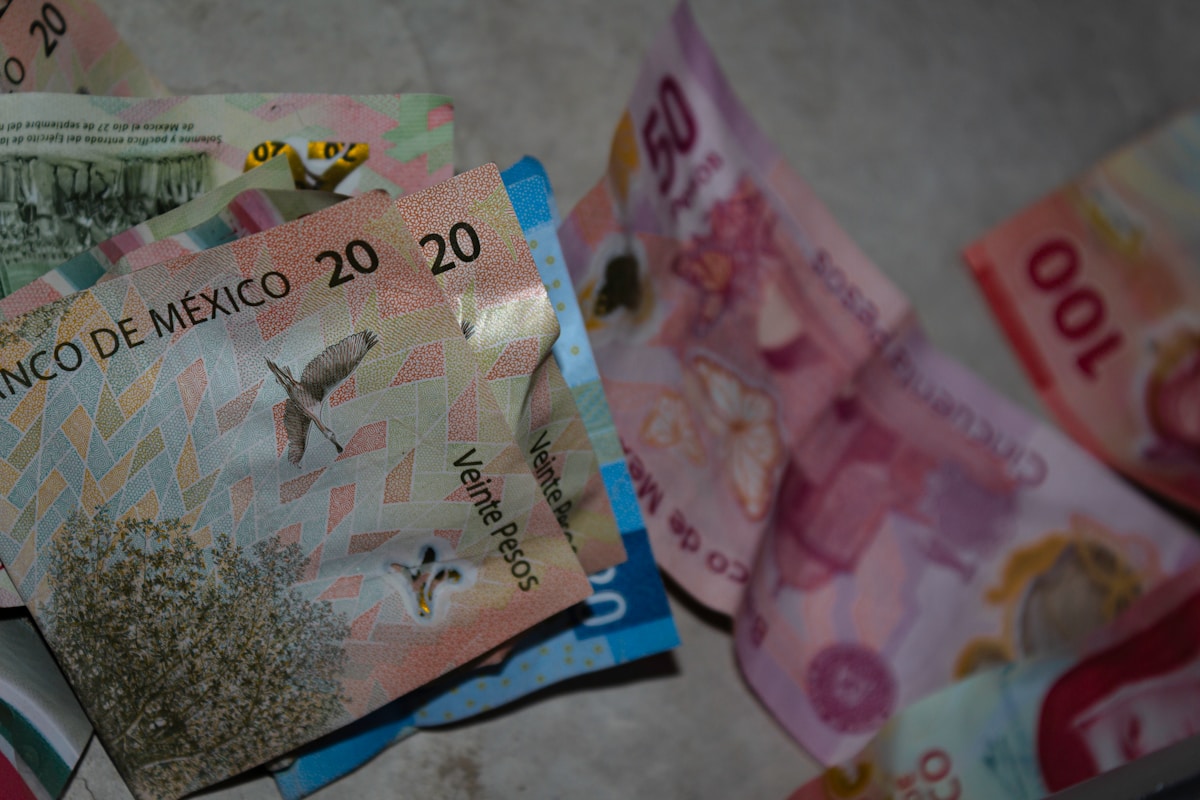
Mexico’s currency is the Mexican peso (MXN). The symbol is $ - which causes confusion because Mexican prices quoted as ”$” are in pesos, not US dollars, unless otherwise specified. Some tourist-area menus and hotels use “USD” or “US$” to distinguish dollar prices. Always confirm which currency is being quoted.
Exchange rate
The peso floats freely against major currencies. Approximate mid-2026 rates:
| Currency | Approx. rate |
|---|---|
| USD 1 | MXN 17–19 |
| GBP 1 | MXN 22–25 |
| EUR 1 | MXN 18–21 |
| CAD 1 | MXN 13–15 |
| AUD 1 | MXN 11–13 |
Rates vary daily - check Google, XE.com, or a currency app for the current rate before exchanging. The rate you receive at ATMs, exchange bureaux, and hotels will differ from the mid-market rate by varying margins.
Best ways to get pesos
ATMs (recommended)
Withdraw pesos directly from Mexican bank ATMs using your debit or credit card. You receive a wholesale exchange rate - typically 1–3% from the mid-market rate, which is better than any currency exchange bureau.
Recommended bank ATMs: HSBC, Banamex (Citibanamex), Santander, and Scotiabank. These are found in every city and most towns. Look for ATMs inside bank branches or shopping centres rather than standalone units.
Avoid: Independent (non-bank) ATMs at convenience stores, in tourist areas, or free-standing on streets. These charge higher fees (MXN $80–120 per withdrawal versus MXN $35–65 at bank ATMs) and have higher skimming risk.
Typical ATM fee: MXN $35–65 per withdrawal charged by the Mexican bank, plus any fee charged by your home bank. To minimise per-transaction costs, withdraw larger amounts (MXN $5,000–8,000) less frequently rather than small amounts often.
Important: Many ATMs will offer to convert the amount to your home currency on-screen (Dynamic Currency Conversion or DCC). Always decline this and choose to be charged in Mexican pesos - the DCC rate is significantly worse than your bank’s conversion rate, typically adding 3–7% to the cost.
Notify your bank before travel - otherwise, transactions from Mexico may trigger fraud blocks. Some banks allow you to set travel notifications via their app.
Credit and debit cards
Widely accepted in cities, hotels, larger restaurants, shopping centres, and tourist areas. Visa and Mastercard have the best acceptance; American Express is less widely accepted in Mexico. Contactless payment is increasingly common in urban areas.
Where cards are not accepted: street food stalls, market vendors, colectivos, small-town shops, local taxis, and many budget restaurants. In these situations, cash is essential.
Card fees: Check your card’s foreign transaction fee before travel. Many UK and European travel-friendly cards (Monzo, Revolut, Starling, Wise) charge no foreign transaction fees. Most US bank cards charge 1–3% on international transactions. Using a no-fee card saves significantly over a 2–3 week trip.
Currency exchange bureaux (casas de cambio)
Available at airports, downtown areas, and tourist zones. Rates are worse than ATMs by 3–8%.
Airport exchange kiosks offer the worst rates - margins of 8–15% below the mid-market rate are common at Cancún and Mexico City airports. Only use them if you need pesos immediately and there is no ATM nearby. Exchange the minimum amount (MXN $500–1,000) to cover a taxi or bus, then use a bank ATM for larger withdrawals.
City-centre casas de cambio offer better rates than airports but still worse than ATMs. They are useful if you need to exchange cash (USD, EUR, GBP) and do not have a card with low ATM fees. Compare rates at 2–3 bureaux - pricing varies, and some will negotiate on larger amounts (USD $200+).
Should you use US dollars?
USD is widely accepted in Cancún, Playa del Carmen, Los Cabos, and other heavily visited tourist areas - but always at an exchange rate unfavourable to you. If a price is quoted in dollars and you pay in dollars, you are effectively paying a 5–15% surcharge compared to paying the peso equivalent. Pay in pesos wherever possible.
In the rest of Mexico (Mexico City, Oaxaca, Mérida, Guadalajara, colonial cities), US dollars are rarely accepted at shops, restaurants, or local businesses. Pesos are the only practical option.
Exception: Some hotels, tour operators, and upscale restaurants in tourist zones quote prices in dollars and accept dollar payments at a published rate. Check whether the rate offered is reasonable before agreeing.
Coins and notes in circulation
Notes: MXN $1,000 / $500 / $200 / $100 / $50 / $20
Coins: MXN $10 / $5 / $2 / $1 / 50 centavos / 20 centavos
The MXN $500 and $1,000 notes are commonly dispensed by ATMs but difficult to spend at small vendors, street stalls, and markets - many cannot make change. Break large notes at supermarkets (Walmart, Soriana, Chedraui), OXXO convenience stores, or pharmacies before heading to markets or street food areas. Request smaller denominations at the ATM when the option is available.
Polymer notes: Mexico’s notes are made of polymer (plastic), which is durable and harder to counterfeit. They survive washing machine accidents better than paper currency.
Tipping guide
Mexico has a tipping culture - tipping is expected in service situations:
| Situation | Standard tip |
|---|---|
| Restaurants (sit-down) | 10–15% of the bill |
| Upscale restaurants | 15–20% |
| Taxi drivers | Round up to nearest MXN $10; not obligatory |
| Uber/DiDi drivers | Optional; round up or MXN $10–20 |
| Tour guides | MXN $100–200 per person for a half-day |
| Hotel porters | MXN $30–50 per bag |
| Hotel housekeeping | MXN $50–100 per night |
| Gas station attendants | MXN $10–20 (they pump your fuel) |
| Supermarket bag packers | MXN $5–10 (typically teenagers or elderly volunteers) |
| Parking attendants (viene-vienes) | MXN $10–20 |
| Musicians (at your table) | MXN $50–100 per song |
Cash tips in pesos are preferred. Card tip options are available at many restaurants, but staff do not always receive these directly - ask whether the tip reaches the server if paying by card.
Budgeting and tracking
Keeping rough track of spending in pesos is easier than converting constantly. A useful mental shortcut at the current rate: divide the peso price by 18 to get the approximate USD equivalent. MXN $1,000 ≈ USD $55; MXN $100 ≈ USD $5.50.
OXXO convenience stores (found on virtually every block in Mexican cities) accept both cash and cards, sell everything from SIM top-ups to snacks, and are the easiest place to break large notes. They are open 24 hours.
Plan your trip: flights to Mexico · travel insurance · tours across Mexico.
Related Practical Guides
- Tipping in Mexico - detailed tipping guide for every service situation
- Mexico Budget Costs - daily budget estimates across different travel styles
- SIM Card Guide for Mexico - mobile data options to complement cash and cards
- First Time in Mexico - complete preparation guide including money and safety
- Mexico City Travel Guide - ATMs and card acceptance in the capital
- Cancún Travel Guide - tourist zone where USD is often accepted
Ready to Plan Your Trip?
See our itineraries for inspiration:
- 1 Week Mexico - one week covering Mexico City, Oaxaca and the beach
- 10 Days Mexico - ten days from the capital to the Caribbean
- 2 Weeks Mexico - the two-week Mexico circuit
- Budget Mexico Itinerary - a full Mexico trip on a budget