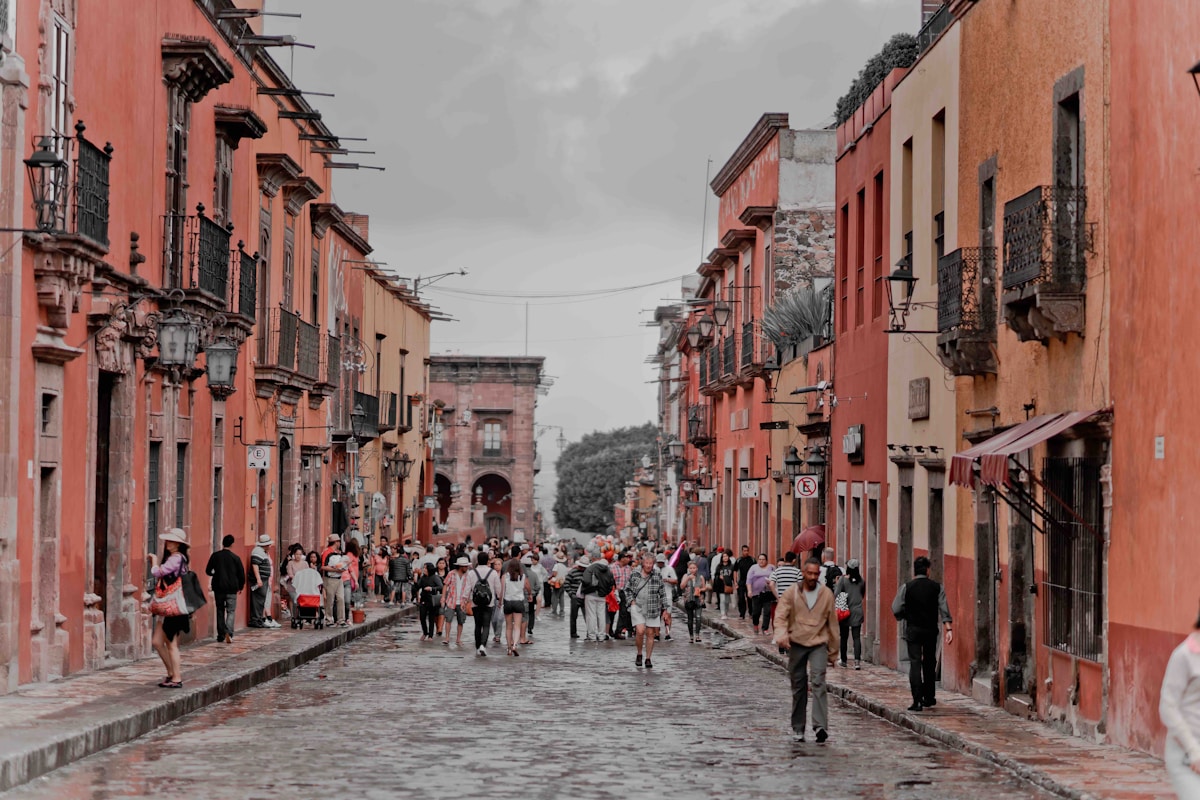
San Miguel de Allende sits at 1,880 metres in the Bajío highlands of central Mexico, two and a half hours by road from Mexico City and 90 minutes from León airport. It is a UNESCO World Heritage city of 75,000 people with a storied history of attracting artists, retirees, and now remote workers. As a digital nomad base, it is unconventional - smaller, quieter, and more expensive than Mexico City or Playa del Carmen, but it offers something those cities cannot: a genuinely beautiful place to spend six months working from café terraces with views of 18th-century baroque churches.
Who San Miguel suits
San Miguel is a strong fit for:
- Experienced remote workers with stable income who want a high-quality lifestyle over cheapness
- Writers, designers, and creative professionals drawn to the arts scene
- Nomads considering retirement and testing long-term expat life in Mexico
- Couples where one partner wants a slower, culturally rich base
- Anyone who finds Mexico City overwhelming but still wants access to a vibrant cultural scene
It is a poorer fit for:
- Nomads on tight budgets (Oaxaca and Guadalajara offer more for less)
- Developers or tech workers who need access to a tech community or networking events
- People who need direct international flight access (León airport has limited routes; Mexico City is two and a half hours away)
Internet and infrastructure
San Miguel’s internet infrastructure has improved substantially since 2020. Fibre connections are available throughout the centro and most residential neighbourhoods, with 100-300 Mbps down the norm for home connections. Two providers dominate:
- Telmex Infinitum: 100 Mbps MXN 449/month; 300 Mbps MXN 599/month - widely available, reliable
- Megacable: 200 Mbps MXN 489/month; 400 Mbps MXN 649/month - slightly faster but less ubiquitous
Both providers typically require a two to three week installation wait. For the first week or two, Airbnb hosts’ connections and coworking day passes fill the gap. Mobile data (Telcel, AT&T México) provides reliable 4G/LTE throughout the city centre.
Power outages are infrequent but do occur, particularly during summer storm season (June through September). A small UPS (uninterruptible power supply) is worth the investment if you are on video calls regularly; MXN 600-1,200 at Office Depot in Querétaro or ordered online.
Coworking spaces
San Miguel’s coworking scene is modest compared to Mexico City or Playa del Carmen, but it covers the essentials.
WorkHere San Miguel is the most established coworking space in the city, located near Parque Benito Juárez. It offers dedicated desks from MXN 3,500/month, hot desks from MXN 2,800/month, and day passes at MXN 250. The space has a rooftop terrace and hosts occasional community events for the nomad and expat community.
Craft Cowork operates from a converted colonial building near the Mercado Seco and offers a quieter, more design-focused environment. Monthly memberships from MXN 3,200; day passes MXN 280.
Many long-term residents work from home in rented apartments, which in San Miguel often means working from a terrace or rooftop with Guanajuato state mountain views. The architecture of the city makes this particularly appealing - well-lit, high-ceilinged colonial rooms are common even in mid-range rentals.
Best cafes for working
San Miguel has excellent coffee culture for a city its size.
Café Organico on Ancha de San Antonio is a San Miguel institution - specialty coffee from Oaxacan and Veracruz producers, reliable Wi-Fi, tables with good natural light. Opens 8am; gets busy post-10am. Americano MXN 55; pour-over MXN 75.
La Conexión on Hernandez Macias runs a café and expat resource centre with consistent Wi-Fi and a comfortable working environment. Good for meeting other English-speakers working remotely.
Dôme Café near the Jardín Principal has a rooftop terrace with views of the Parroquia. Wi-Fi is adequate for email and video calls; not ideal for large file transfers at peak hours. Excellent for the occasional afternoon working session. Flat white MXN 70.
El Café de la Mancha in the Barrio El Chorro neighbourhood is calmer than centro cafes and offers more desk-style seating. Strong Wi-Fi and a rotating menu of local pastries.
Neighbourhoods for nomads
Centro Histórico
The historic centre is the most desirable and most expensive area. Cobblestone streets, views of the Parroquia, walking distance to everything. One-bedroom furnished apartments run MXN 14,000-22,000/month. Noise can be a factor on weekends with tourism and events.
Guadiana and San Antonio
These neighbourhoods sit just south and southeast of the centro. Slightly quieter, residential character, still walkable to the main square. Two-bedroom apartments run MXN 12,000-18,000/month. Good balance of access and livability.
El Chorro and Barrio Las Flores
More local character, slightly further from tourist activity. Lower rents (two-bedroom from MXN 9,000-14,000/month) and a calmer atmosphere. Popular with longer-term residents and those wanting more authentic neighbourhood life.
Colonia San Rafael and Guanajuato Road area
More modern residential areas outside the historic core, with some gated communities and newer construction. Better suited to retirees with cars than nomads who prefer walkability.
Accommodation costs
San Miguel accommodation is expensive by Mexican standards. Budget for:
- Studio or one-bedroom furnished, centro: MXN 12,000-20,000/month
- Two-bedroom furnished, centro: MXN 18,000-30,000/month
- Two-bedroom, outer neighbourhoods: MXN 9,000-16,000/month
- Shared room in coliving or house: MXN 5,000-8,000/month
Platforms like Airbnb and direct Facebook groups (search “San Miguel de Allende rentals”) are the main channels for finding furnished apartments. Long-stay discounts of 20-30% off nightly rates are common for bookings over 28 days. Most leases in the expat market are informal - a simple contract between tenant and landlord, typically six to twelve months, with one month’s deposit.
Hotels in San Miguel de Allende
Visa options for remote workers
Mexico does not have a specific digital nomad visa. Remote workers typically enter on a tourist FMM permit (up to 180 days per entry) or hold a Temporary Resident visa.
Tourist permit (FMM): Free to obtain at entry. Technically for tourism, not work. Grants up to 180 days (the number of days is at the immigration officer’s discretion - request the full 180 on arrival). Most remote workers use this approach for stays under six months. Border runs to reset the permit are possible but increasingly scrutinised.
Temporary Resident visa: Applied for at a Mexican consulate before entering Mexico. Requires proof of income (approximately USD 2,600/month) or savings (approximately USD 43,000). Valid for one to four years and renewable. Opens access to bank accounts, IMSS healthcare, and a more stable legal status. The right choice for anyone planning to stay over six months.
Temporary Resident - rentista: A subcategory of the Temporary Resident visa specifically for those with passive income (pensions, investments, rental income from abroad). Well-suited for older nomads or those with investment income.
Monthly cost of living
Realistic monthly budget for a single digital nomad in San Miguel:
| Expense | Budget | Mid-range |
|---|---|---|
| Rent (1BR, furnished) | MXN 10,000-13,000 | MXN 14,000-20,000 |
| Groceries | MXN 2,500-3,500 | MXN 4,000-6,000 |
| Eating out | MXN 2,000-3,500 | MXN 4,000-7,000 |
| Coworking | MXN 2,800-3,500 | MXN 3,500-4,500 |
| Transport (Uber + occasional car hire) | MXN 1,000-2,000 | MXN 1,500-3,000 |
| Utilities + internet | MXN 1,200-2,000 | MXN 1,500-2,500 |
| Health insurance | USD 80-120 | USD 120-200 |
| Entertainment | MXN 1,000-2,000 | MXN 2,000-4,000 |
| Total (approx) | USD 1,500-2,000 | USD 2,000-3,000 |
San Miguel is 30-50% more expensive than Oaxaca City or Guadalajara for comparable accommodation. The premium buys you a higher baseline aesthetic quality and a stronger existing expat infrastructure, but does not increase productivity per se.
Transport in and around San Miguel
San Miguel has no public city bus system comparable to larger Mexican cities. Transport within the city is on foot (the historic centre is very walkable) or by Uber (widely available, average trip MXN 60-100). Motorcycles and bicycles are practical options for local errands.
To León/Bajío International Airport (90 minutes, serves direct flights to US cities including Dallas, Houston, Chicago): shared shuttles from MXN 300-400 per person; private taxi MXN 700-900.
To Mexico City (NAICM or AIFA airports): ADO first-class bus from MXN 350-550 (approximately 3.5 hours via querétaro); or drive 2.5 hours on the 57D.
To Querétaro (1 hour south): taxi or bus from MXN 150-250. Querétaro has a larger commercial centre, IKEA, Costco, and specialist medical facilities used by San Miguel expats.
The expat and nomad community
San Miguel has an unusually cohesive expat community for a city of its size. The San Miguel English Language Library hosts events, has a large book collection, and is a practical social hub. The Jardin Principal fills with expats and locals on weekend evenings. The city’s cultural calendar is dense: art gallery openings, classical concerts, visiting speakers, festivals.
Nomads younger than 40 sometimes find the social scene skews older (toward retirees in their 50s-70s) and prefer Mexico City or Oaxaca for peer group. The city’s social fabric genuinely integrates foreign and Mexican residents more than many expat cities in Mexico, making it easier to build mixed friendships rather than staying entirely within an English-speaking bubble.
Practical tips for arriving nomads
- The altitude (1,880 metres) causes mild altitude sickness in some arrivals during the first few days - drink extra water and take it easy
- San Miguel has no Walmart; Costco and commercial supermarkets are in Querétaro (1 hour) or Celaya (45 minutes)
- The Sunday tianguis (outdoor market) near the bus terminal is the best source for fresh local produce at the lowest prices
- Facebook groups: “San Miguel de Allende Expats” (35,000+ members) is the most active English-language community resource; rental listings, recommendations, and local advice all available there
- Medical care: Hospital HSMA and Hospital MAC San Miguel de Allende cover most routine and emergency needs; complex specialist care means a trip to Querétaro or Mexico City