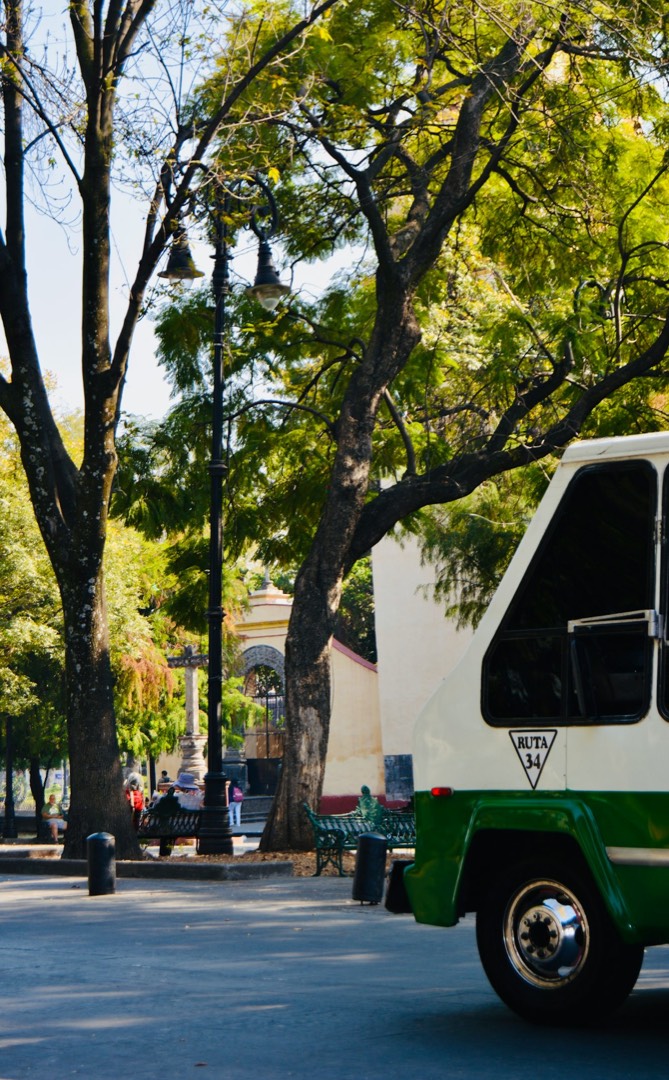
The colectivo (also called a combi or pesero depending on the city) is a shared minibus that runs a fixed route, picks up and drops off passengers anywhere along it, and costs a fraction of what a taxi charges. In Mexico City, the Yucatán Peninsula, and dozens of other cities, it’s how millions of people get around every day. Once you’ve used one, you’ll reach for it automatically.
What Is a Colectivo?
A colectivo is typically a Volkswagen van, Ford Transit, or similar vehicle modified with rows of bench seating. The driver runs a fixed route, collecting passengers along the way until the van is full (hence colectivo — collective). Passengers can board or exit anywhere on the route, not just at formal stops.
In Mexico City, these are historically called combis or peseros (from the old one-peso fare). Modern Mexico City transit has phased out many traditional combis in favour of the Metrobús and expanded metro, but colectivos remain dominant in suburban areas, secondary routes, and cities and towns across the country.
Mexico City: Where Colectivos Still Rule
Within Mexico City’s formal districts, the metro, Metrobús, and Trolebús cover most routes efficiently. But in outer colonias, peripheral zones like Xochimilco, Tlalpan, and Milpa Alta, and in connecting routes between metro stations and residential areas, colectivos are the primary transport.
Fares in Mexico City: approximately 10–15 MXN per ride as of 2026, depending on route length. You pay as you board or when the driver’s assistant collects from the back. Cash only; small coins and notes (10, 20 MXN) are preferred.
How to use them in Mexico City:
- Look for vans with a destination sign in the windscreen or displayed on a card on the dashboard.
- Stand at the roadside and raise your hand.
- State your destination or a major landmark before boarding. If the driver nods, you’re on the right van.
- Sit, pay, and when you’re close to your stop, say “aquí” (here) or “en la esquina” (at the corner). The driver stops.
The Yucatán: Colectivos as the Default Transport
In the Yucatán Peninsula — particularly the Riviera Maya corridor — colectivos are the single most useful transport tool for budget travellers. They run between Cancún, Playa del Carmen, Tulum, and smaller towns at a fraction of taxi prices.
Cancún to Playa del Carmen: approximately 45–55 MXN per person as of 2026, departing from Cancún’s downtown terminal on Avenida Uxmal. Travel time: 45–60 minutes depending on stops.
Playa del Carmen to Tulum: approximately 80–100 MXN per person, departing from Calle 2 Norte near the ADO bus station. Travel time: 1–1.5 hours.
Playa del Carmen to Akumal / Xel-Há / Cobá turnoff: colectivos run the Highway 307 corridor and will drop passengers at roadside junctions to cenotes, beach clubs, and ruins — tell the driver your stop.
Within Tulum town: local combis circulate between the town (pueblo) and the hotel/beach zone (zona hotelera) for approximately 25–35 MXN. They run until around 10pm.
Other Cities: How Colectivos Vary
Oaxaca: Colectivos called transportes de pasaje run fixed routes within the city for 6–8 MXN and between Oaxaca and surrounding villages (Monte Albán turnoff, Mitla, Tlacolula) from the second-class bus terminal on Prolongación de Las Casas.
San Cristóbal de las Casas (Chiapas): Combis and colectivos serve routes within the city and to nearby indigenous villages like San Juan Chamula and Zinacantán. Fares: 10–15 MXN city, 20–40 MXN for nearby villages.
Guadalajara: Suburban routes and connections between urban centres and outlying colonias are largely covered by local colectivos alongside the city’s own tram and BRT systems.
Colectivo vs. Taxi vs. ADO Bus
| Colectivo | Taxi | ADO Bus | |
|---|---|---|---|
| Cost | Very low | High | Medium |
| Routes | Local/regional | Anywhere | Major routes |
| Flexibility | Drop anywhere on route | Door to door | Fixed terminals |
| Luggage | Day bags only | Fine | Hold luggage OK |
| Night service | Limited | 24/7 | Frequent |
For travel between major Yucatán destinations, the colectivo undercuts ADO fares by 60–70% with only a small time penalty. For solo short-haul travel, it’s the obvious choice. For late-night travel, airport transfers, or journeys with large luggage, taxis or ADO are more practical.
Note on safety: Colectivos on main tourist corridors (Cancún–Tulum, Oaxaca–Mitla) are generally straightforward. In Mexico City, stick to clearly marked routes in areas you know during the day. At night, Uber or DiDi are more appropriate — both operate extensively across Mexico City and major cities.
Practical Tips
- Always have small change. 20 MXN notes and coins are ideal. Drivers on packed vans won’t easily break a 200.
- State your stop before or immediately after boarding. On longer routes, the driver needs to know whether to stop mid-route.
- Watch for your stop. No announcements, no displays. Track your location on Google Maps offline (download the relevant region before traveling) and call your stop when you’re close.
- Luggage. A day pack fits easily; a large backpack is awkward. For routes where you’re carrying significant luggage, the ADO bus is a more comfortable call.
- Destination signs vary. In smaller cities, the route is sometimes just a hand-written card. Asking locals “¿Este va a [destination]?” before boarding takes ten seconds and avoids a wrong-direction ride.
The colectivo is Mexico’s unofficial mass transit system — underpriced, omnipresent, and one of the most reliable ways to move like a local. Learn it once, use it everywhere.