Mexico consistently ranks among the top three retirement destinations worldwide for North Americans and Europeans - and for good reason. The combination of low costs, warm climate, rich culture, quality healthcare, and physical proximity to the US and Canada makes it uniquely accessible. This guide covers everything you need to know about retiring in Mexico: visa requirements, healthcare, monthly costs, and the best cities for different retirement styles.
Why retirees choose Mexico
The core appeal is straightforward: your retirement income goes further. A pension or Social Security payment that barely covers rent in California or Ontario can fund a genuinely comfortable life in Mexico - private apartment, housekeeper, restaurant meals, travel within the country, and quality healthcare.
Beyond cost, Mexico offers geographic diversity few countries match. You can retire to a colonial city at altitude with perfect year-round temperatures, a Pacific beach town with a surf scene, a Caribbean-side city with cenotes on your doorstep, or an agricultural highland known for mezcal and textiles. The country has distinct expat communities in about a dozen cities, meaning you will find English-speaking neighbours, imported food products, and established social networks wherever you land.
Infrastructure for foreigners has matured significantly. Tax advisors who understand US-Mexico obligations, immigration lawyers handling residency paperwork, healthcare coordinators at private hospitals - these services are well-established in the main expat cities.
Visa options for retirees
Temporary Resident visa
The Temporary Resident visa is the starting point for most retirees. It is valid for one year initially and renewable for up to four years. You apply at a Mexican consulate in your home country - not on arrival.
Income requirements (approximate, as of 2026):
- Approximately USD 2,600/month from a pension, Social Security, or investment income
- OR a lump sum in a bank account of approximately USD 43,000 (12 months x ~3,580 USD equivalent)
Requirements vary slightly by consulate. Bring three to six months of bank statements showing consistent income, proof of accommodation in Mexico (a lease or letter of invitation), and a completed application form. The consulate issues a visa sticker in your passport; you then have 30 days after arrival to exchange it for a physical resident card (tarjeta de residente) at the INM (National Migration Institute) office.
Temporary residents can open bank accounts, rent property, own a vehicle, and bring household goods duty-free within six months of arrival.
Permanent Resident visa
After four years of temporary residency, you can apply for permanent residency. You can also apply directly if your income exceeds approximately USD 3,400/month or you have a lump sum of around USD 170,000 in savings. Permanent residents have no renewal requirements and can apply for Mexican citizenship after five years.
The Permanent Resident visa is processed the same way - at a consulate before entry - and requires similar documentation plus evidence of your prior residency status if converting from temporary.
The tourist/FMM approach (not recommended for retirees)
Many people enter Mexico on a tourist permit (FMM) for up to 180 days and leave to reset. This is technically legal but creates uncertainty - border officers can grant fewer days, and extended stays can draw scrutiny. Retirees intending to stay long-term are better served by formal residency, which also unlocks IMSS healthcare access and eliminates the inconvenience of border runs.
Healthcare for expat retirees
Healthcare is one of Mexico’s strongest selling points for retirees from the US. A specialist consultation at a reputable private clinic costs MXN 800-1,500 (approximately USD 40-75). A private room in a quality hospital runs MXN 3,000-6,000/night (USD 150-300). Even complex procedures like cardiac surgery or hip replacement cost 40-60% less than equivalent care in the US.
Private health insurance
Most expat retirees carry private health insurance. Options include:
- Mexican private insurance (e.g., GNP Seguros, Mapfre, Seguros Monterrey): plans for a 65-year-old run approximately USD 150-250/month. Policies are in Spanish and cover a national network.
- International expat insurance (e.g., Cigna Global, Allianz Care, Aetna International): broader coverage including evacuation; costs USD 250-500/month for a 65-year-old depending on deductible.
IMSS (Instituto Mexicano del Seguro Social)
Legal residents can voluntarily enroll in IMSS, Mexico’s public healthcare system, for approximately MXN 3,000-5,000 per year (USD 150-250). Quality varies significantly by location and facility. In major cities, IMSS covers hospitalisation, surgery, specialist visits, and prescriptions. Many expats use IMSS as a safety net and pay out-of-pocket for private specialist care.
Pharmacy costs
Prescription medications are dramatically cheaper than in the US or UK. Common medications for blood pressure, diabetes, and cholesterol cost MXN 100-400 per month at Farmacias del Ahorro or Farmacia Guadalajara chains. Many medications available only by prescription in the US are sold over the counter in Mexico.
Monthly cost of living breakdown
These figures reflect a two-person household in a mid-range lifestyle (private apartment, mix of home cooking and restaurants, some travel).
| Expense | Budget city (e.g., Mérida) | Mid-range (e.g., Lake Chapala) | Higher cost (e.g., San Miguel de Allende) |
|---|---|---|---|
| Rent (2BR apt) | MXN 8,000-12,000 | MXN 12,000-18,000 | MXN 15,000-25,000 |
| Utilities (electric, water, internet) | MXN 1,500-2,500 | MXN 2,000-3,000 | MXN 2,000-3,500 |
| Groceries | MXN 3,000-5,000 | MXN 4,000-7,000 | MXN 5,000-8,000 |
| Dining out (2x week) | MXN 1,500-2,500 | MXN 2,500-4,000 | MXN 3,000-5,000 |
| Transport (no car) | MXN 500-1,000 | MXN 800-1,500 | MXN 1,000-2,000 |
| Health insurance (2 people) | USD 300-500 | USD 300-500 | USD 300-500 |
| Housekeeper (2x week) | MXN 1,200-2,000 | MXN 1,500-2,500 | MXN 2,000-3,500 |
| Total (approx) | USD 1,200-1,800 | USD 1,600-2,400 | USD 2,000-2,800 |
Air conditioning is a major variable - in Mérida and Puerto Vallarta, summer electricity bills can reach MXN 3,000-5,000/month. High-altitude cities like Oaxaca, San Miguel, and Lake Chapala rarely need air conditioning.
Best cities for retirees in Mexico
Lake Chapala and Ajijic
The Lake Chapala area - particularly the village of Ajijic on the north shore - has the largest concentration of expat retirees in Mexico, estimated at 10,000-15,000 foreign residents. The lake sits at 1,500 metres altitude, producing a climate so consistently mild (average 22°C year-round) that it is nicknamed the “world’s best climate” in some retirement publications.
The infrastructure for foreigners is exceptional: multiple English-language newspapers, theatre groups, art galleries, expat clubs, and a strong social scene. Private healthcare is available in Guadalajara (45 minutes away), with shuttle services organised specifically for retirees attending medical appointments.
Accommodation ranges from simple apartments for MXN 9,000/month to lakefront houses for MXN 25,000+. The main criticism is that the expat community can feel insular - retirees looking to integrate into Mexican life often prefer smaller cities with less established foreign populations.
San Miguel de Allende
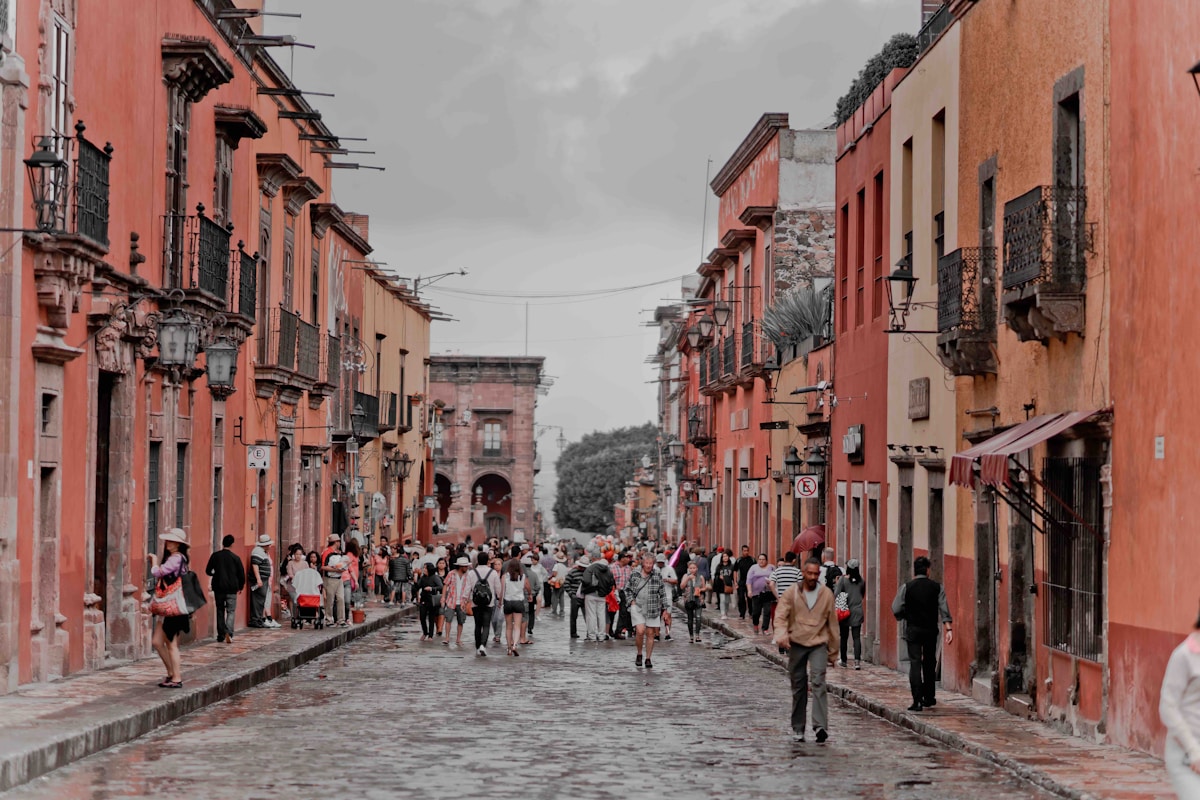
San Miguel de Allende (population 75,000, altitude 1,880 metres) is Mexico’s most celebrated colonial city - a UNESCO World Heritage Site with cobblestone streets, baroque churches, and a thriving arts scene. It has attracted expats since the 1940s, and the blend of foreign and Mexican culture is genuinely integrated rather than segregated.
The downside is cost: San Miguel is Mexico’s most expensive mid-tier city for rent. A two-bedroom apartment in the historic centre runs MXN 18,000-30,000/month; properties further from the centre cost MXN 12,000-18,000. The city has no beach, no direct international flights (León/Guanajuato airport is 90 minutes away), and limited public transport within the city.
For culturally-minded retirees who value aesthetics, community events, and a pedestrian-friendly lifestyle over beach access or low cost, San Miguel remains hard to beat.
Hotels in San Miguel de Allende
Oaxaca City
Oaxaca City sits at 1,550 metres altitude with average temperatures of 24°C during the day and 14°C at night - no air conditioning, rare heating, no extreme weather. The city is Mexico’s culinary capital, with a food scene built on indigenous ingredients, mole variations, tlayudas, and mezcal distilleries in the surrounding valleys.
The expat community is smaller and younger than San Miguel or Lake Chapala, with more artists, writers, and long-stay digital nomads than classic retirees. This gives Oaxaca a different energy - more integrated with Mexican daily life, less structured around expat social clubs.
Rents are lower than San Miguel: a two-bedroom apartment in Jalatlaco or Santo Tomás Xochimilco costs MXN 10,000-18,000/month. The main practical limitation is healthcare - Oaxaca has private clinics but lacks the specialist infrastructure of Guadalajara or Mexico City. For serious medical needs, a flight to CDMX (one hour) is typically required.
Puerto Vallarta
Puerto Vallarta is the pick for retirees who want both beach and infrastructure. It has a large, established LGBTQ+ expat community and is consistently rated one of Mexico’s most liveable beach cities. The colonial centre (Zona Romántica) is walkable; the Versalles and Marina areas have modern amenities.
Cost of living is moderate-to-high by Mexico standards. A two-bedroom apartment in Versalles or Fluvial Vallarta runs MXN 14,000-22,000/month; beachfront and Marina properties run considerably higher. Healthcare is available locally for most needs, with Guadalajara (four hours by road, or a 45-minute flight) for specialist care.
The main drawback is summer heat and humidity - May through October temperatures regularly reach 34-37°C. Most long-term residents leave for a few months or rely heavily on air conditioning.
Mérida
Mérida is the most affordable city on this list with the most authentic Mexican character. It is the capital of Yucatán state, with a well-preserved colonial centre, excellent public safety record relative to other Mexican cities, and a booming local economy. The expat community is smaller but growing, with most foreigners integrated into Mexican neighbourhoods rather than clustered in expat enclaves.
The challenge is heat. Mérida is one of the hottest cities in Mexico - June through September regularly hits 38-40°C with high humidity. Air conditioning is not optional, which drives up electricity costs. The city is also further from international airports (Cancún is two hours east; Mérida’s own airport has limited direct international routes).
For retirees prioritising authentic cultural immersion, low cost, and a strong sense of local identity over beach or mountain living, Mérida is worth serious consideration.
Taxes and financial considerations
Mexico does not tax foreign pension income at source for non-residents, but tax residency in Mexico (residing more than 183 days per year) means all worldwide income is potentially subject to Mexican tax. The US-Mexico tax treaty prevents double taxation for US citizens.
Most expat retirees retain financial accounts in their home country and transfer money monthly. Wise and Revolut offer competitive exchange rates for regular transfers. Mexican banks (BBVA, Banorte, Santander) are accessible to legal residents; opening an account typically requires your resident card, passport, and proof of address.
Property ownership is possible for foreigners, with some restrictions near coastlines and borders (resolved through a fideicomiso trust for coastal properties).
Getting started
The typical path: visit Mexico for a month or two on a tourist permit to test cities you are considering, then return home to apply for the Temporary Resident visa at your nearest Mexican consulate. Budget six to eight weeks for the application process. Arrive, exchange your visa for a resident card, and begin settling in.
The online communities at Mexexpatriate.com, the Lake Chapala Society, and various city-specific Facebook groups (search “[city] expats” or “[city] retirees”) are active and genuinely helpful for newcomers.