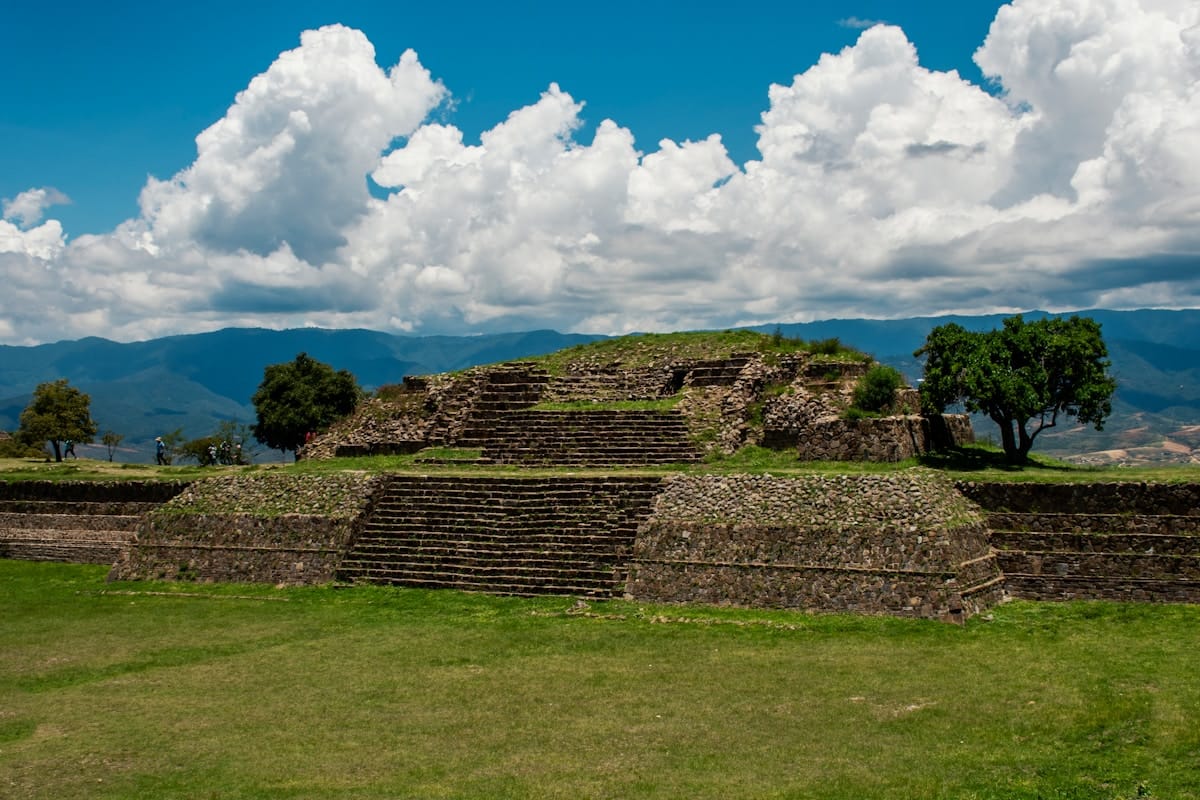
Monte Albán is one of the oldest cities in Mesoamerica and the capital of the Zapotec civilisation for over a thousand years. It sits on a levelled mountain summit approximately 400 metres above the Oaxaca Valley - the decision to build a capital here, without water or agricultural land, appears to have been primarily political: a neutral high ground commanding the valley below. The site is a UNESCO World Heritage Site (inscribed 1987) and one of the most important archaeological zones in Mexico.
History
Monte Albán was founded around 500 BCE when several competing valleys in the Oaxacan region were consolidated under a single political entity. The mountain summit was artificially flattened - an enormous engineering feat - and construction began.
The site went through four major periods:
- Monte Albán I (500–100 BCE): foundation phase. The earliest structures include Building J, aligned to astronomical events. The “danzante” reliefs (carved stone slabs showing figures in contorted positions, once interpreted as dancers, now understood as war captives) date from this period. Over 300 danzante slabs have been catalogued - they represent one of the earliest writing systems in Mesoamerica.
- Monte Albán II (100 BCE – 200 CE): expansion. The main plaza reaches approximately its final form. Diplomatic and trade links with Teotihuacán are established - Teotihuacán-style talud-tablero architecture appears in some structures.
- Monte Albán III (200–700 CE): peak period. Population estimated at 25,000–35,000 across the main hilltop and surrounding terraces. The city controlled an area with over 1,000 terraces carved into the hillsides, housing the wider population. Hundreds of elite tombs are cut into the hillside below the main plaza, many with elaborate painted murals.
- Monte Albán IV (700–950 CE): decline and abandonment. The main city is gradually abandoned, likely due to political fragmentation rather than conquest. The site continues as a sacred burial ground for the later Mixtec culture - Tomb 7, the richest burial found at the site, is Mixtec, not Zapotec.
The site was never settled by the Spanish (they founded Oaxaca City in the valley below) and was not systematically excavated until Alfonso Caso’s groundbreaking campaign in the 1930s–1950s. Caso’s discovery of Tomb 7 in 1932 was one of the most significant finds in Mexican archaeology.
The main plaza
The Gran Plaza is an enormous flat area (roughly 300 × 200 metres) created by levelling the mountain summit. It is surrounded by platforms, pyramids, and palaces. The main structures, moving roughly from north to south:
The North Platform (Plataforma Norte)
The largest structure at the site - a massive raised platform reached by a broad staircase of approximately 40 steps. At the top, a sunken patio is surrounded by smaller temples and a colonnade. The view from the summit looks back down the central axis of the entire city - this was almost certainly the seat of political power. The platform has been partially restored; the colonnade gives a sense of the scale of the elite ceremonial space.
Building J (the Observatory)
The most unusual structure on the plaza - an arrow-shaped (pentagonal) building oriented differently from every other structure on the site. Its internal passages are aligned with specific star risings and the zenith passage of the sun (the two annual days when the sun passes directly overhead at this latitude). The exterior slabs on one face record place-name glyphs - possibly a record of conquered towns. Building J is one of the clearest examples of pre-Columbian astronomical architecture in Mexico and predates the Caracol observatory at Chichén Itzá by centuries.
The Danzantes (Building L)
An exterior wall of a platform covered with carved stone slabs showing human figures in contorted, often naked positions. Early archaeologists interpreted these as dancers (hence the name), but they are now understood as depictions of sacrificed or slain war captives - many show closed eyes (death) and glyphs that may record names or dates. Some show evidence of mutilation. They are among the earliest carved relief sculptures in Mesoamerica.
The Ball Court
A standard I-shaped Mesoamerican ball court on the eastern side of the plaza. Smaller than Chichén Itzá’s famous court but in good condition. The court has the characteristic sloped walls against which the rubber ball was played - the game had both athletic and ritual significance. Monte Albán’s court lacks the stone rings seen at later Maya sites.
South Platform (Plataforma Sur)
The tallest structure at the site, offering panoramic views across the Oaxaca Valley. The climb is steep but rewarding. From the top, the strategic logic of Monte Albán’s location becomes clear - the entire valley is visible, and no approaching force could avoid detection.
Tomb 7
Not visible from the main plaza - located below the north platform on the western slope. This Mixtec burial from the Postclassic period (approximately 1350–1500 CE, centuries after Monte Albán’s Zapotec occupation ended) contained one of the richest tomb assemblages ever found in the Americas.
Alfonso Caso’s 1932 excavation recovered over 400 objects: gold jewellery (including a pectoral depicting a death god), carved jaguar bones, turquoise mosaics, obsidian ear spools, rock crystal goblets, and pearl jewellery. The gold pieces demonstrate lost-wax casting techniques of extraordinary sophistication.
The original objects are now displayed in the Museo de las Culturas de Oaxaca in the Ex-Convento de Santo Domingo in Oaxaca City (entry approximately MXN $90 as of 2026). The site museum at Monte Albán has replicas and contextual exhibits. The city museum collection is essential viewing for understanding what made this site significant - plan to visit it on the same day or the following day.
The surrounding landscape
Monte Albán’s zone extends well beyond the main plaza. Over 2,000 terraces have been identified on the hillsides, many with residential structures. Several satellite plazas and tomb groups are accessible via trails from the main plaza - these areas are less visited and offer a quieter experience:
- Tomb 104: one of the most important painted tombs, with polychrome murals depicting deities and ceremonies (not always open to visitors - check with site staff)
- Tomb 105: also features painted murals in Zapotec style
- The Atzompa group: a secondary hilltop site approximately 3 km north, recently opened to visitors (separate ticket, approximately MXN $75). Atzompa appears to have been an administrative centre linked to Monte Albán’s main complex
Visiting
Entry fee: Approximately MXN $90 as of 2026. Additional fee for video cameras.
Opening hours: 8 am–5 pm daily. Last entry at 4:30 pm.
Getting there: Colectivos (shared minibuses) leave from Calle Minas 518 (near the Hotel Rivera del Ángel) in Oaxaca City throughout the day from approximately 8:30 am to 3:30 pm. Journey time approximately 20 minutes. Return colectivos from the site run until 5 pm. Cost approximately MXN $70 return. Taxis from the city centre cost approximately MXN $150–200 one way.
Time needed: 2–3 hours covers the main plaza thoroughly. Add 1–2 hours for the outlying tomb groups and trails.
What to bring: Hat, sunscreen, water (vendors sell water inside the site at approximately MXN $25–40), comfortable shoes. The plaza is fully exposed to the sun - there is almost no shade. Mornings are significantly more comfortable.
Best time: Arrive at 8 am opening to avoid tour groups (which typically arrive from 10 am). The light is best for photography in the early morning.
Guide services: Licensed guides are available at the entrance for approximately MXN $500–800 per group (up to 5–6 people). A guide significantly improves the experience - the structures are not heavily labelled and the historical context is complex.
Combined visit: Monte Albán in the morning + Museo de las Culturas de Oaxaca (in the Ex-Convento de Santo Domingo) in the afternoon is the ideal combination. The museum provides essential context for the artefacts, particularly the Tomb 7 treasures. The museum is open Tuesday–Sunday, 10 am–6:30 pm, entry approximately MXN $90.
Context within Oaxacan history
Monte Albán is one of three major archaeological sites in the Oaxaca Valley, each from a different period:
| Site | Period | Culture | Distance from Oaxaca City |
|---|---|---|---|
| Monte Albán | 500 BCE – 700 CE | Zapotec | 9 km (20 min) |
| Mitla | 750–1520 CE | Mixtec/Zapotec | 44 km (1 hour) |
| Yagul | 500 BCE – 1520 CE | Zapotec | 36 km (45 min) |
Mitla is the site that succeeded Monte Albán as the Zapotec centre - its mosaic fretwork (grecas) is architecturally unique in Mesoamerica. A day trip combining Monte Albán (morning) with Mitla and a stop at the Tule Tree (afternoon) is a common Oaxaca itinerary, though this is a full and tiring day.
Plan your trip: tours in Oaxaca.
Related City Guides
- Oaxaca City Travel Guide
- Things to Do in Oaxaca City - how Monte Albán fits into a wider Oaxaca itinerary
- Day Trips from Oaxaca City - Mitla, Hierve el Agua, and other sites to combine with Monte Albán
- Oaxacan Mole Guide - the cuisine to pair with your archaeological visit
Search hotels in Mexico on Booking.com
- Mexico City to Oaxaca Route - itinerary placing Oaxaca in a wider southern Mexico circuit