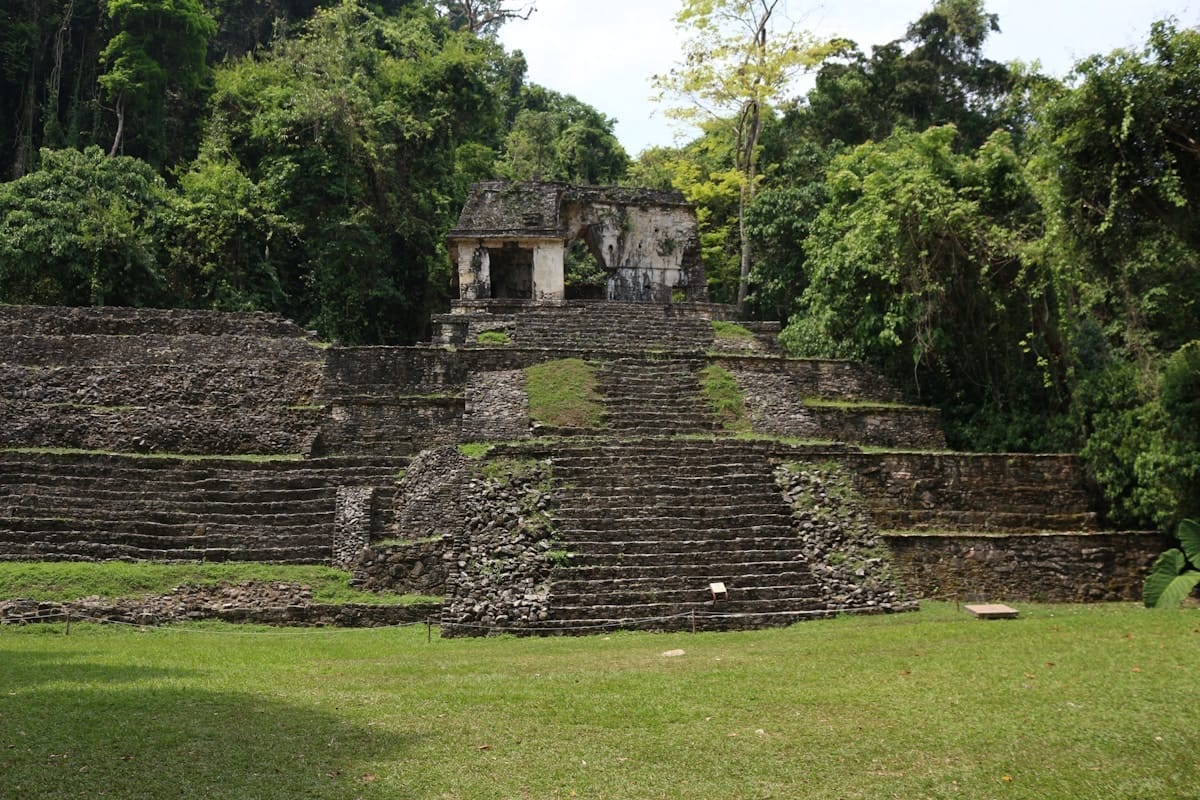
Palenque is among the most significant Mayan sites in the Americas - not the largest, but the richest in decipherable hieroglyphic texts, and the site where one of the most important archaeological discoveries in Mexico’s history was made: the intact tomb of K’inich Janaab’ Pakal I, ruler of Palenque from 615 to 683 AD. The jungle setting in the Chiapas foothills, with mist and howler monkeys, makes it one of the most atmospheric ancient sites on the continent.
Background
Palenque (classical name: Lakamha, “Big Water”) reached its peak under Pakal the Great and his sons Kan Balam II and K’an Joy Chitam II. The architectural and sculptural achievements of this dynasty produced the site’s finest monuments. Palenque was abandoned around 800 AD, likely due to regional drought and political collapse; the jungle covered it within decades. It was rediscovered by Spanish colonial officials in the 1780s and has been partially excavated since the 19th century.
Temple of the Inscriptions (Templo de las Inscripciones)
The most important structure at Palenque. A nine-level pyramid with a temple at the top - the nine levels correspond to the nine levels of the Maya underworld. Inside the temple are three large limestone tablets with the second-longest hieroglyphic text at any Mayan site (620 glyphs), recording Palenque’s dynastic history.
In 1952, Mexican archaeologist Alberto Ruz Lhuillier discovered a hidden staircase inside the pyramid leading 25m below to an intact royal tomb - the burial chamber of Pakal the Great. The chamber contained Pakal’s skeleton, jade mosaic burial mask, jade jewellery, and carved limestone sarcophagus lid. The original contents are in the Museo Nacional de Antropología in Mexico City. A reproduction of the sarcophagus lid is displayed in the site museum at Palenque.
The tomb is closed to public entry - you can visit the pyramid exterior and the temple on top; the staircase to the tomb is sealed. The site museum is the best place to see the finds.
The Palace (El Palacio)
A complex of buildings arranged around four courtyards - the administrative and residential centre of ancient Palenque. The distinctive four-storey tower is the only structure of its type at any Mayan site; its function remains debated (astronomical observatory, watchtower). The palace’s stucco relief panels and hieroglyphic inscriptions are among the best-preserved at any Mayan site.
Group of the Cross (Grupo de las Cruces)
Three temples arranged around a central plaza: the Temple of the Cross, the Temple of the Foliated Cross, and the Temple of the Sun. Each contains a carved stone tablet at its centre recording the mythology of Palenque’s ruling dynasty. The tablets depict Kan Balam II receiving power from Pakal’s shade. The detail and state of preservation are exceptional.
The site museum (Museo de Sitio)
Located 1.5 km from the archaeological zone (downhill, on the road toward the town). Houses the best preserved carved panels and stucco pieces from the site, including a copy of Pakal’s sarcophagus lid and a reconstruction of the tomb chamber. Entry is separate from the ruins (~MXN 65).
Practical information
- Opening hours: 8am–5pm daily
- Entry: ~MXN 90 (ruins) + ~MXN 65 (museum, separate ticket)
- Best time: 8am opening - the site is shaded by jungle until mid-morning; goes into direct sun by 10–11am
- Getting there: buses from Palenque town to the site entrance depart from the market area and the ADO terminal - 15 minutes, MXN 30–50. The site entrance is at the top of the hill; the museum is at the bottom.
- Wildlife: howler monkeys are common in the trees at the site - audible from early morning. Also: coatis (raccoon-like mammals that beg for food; don’t feed them).
Plan your trip: tours in Palenque.
Related City Guides
- Palenque Travel Guide
- Things to Do in Palenque - waterfalls, Bonampak, and Yaxchilán to combine with the ruins
- San Cristóbal de las Casas Travel Guide - 5 hours south, the highland base for Chiapas
- Oaxaca–Chiapas Itinerary - a route placing Palenque in a wider southern Mexico journey
Search hotels in Palenque on Booking.com
- Mexico City Travel Guide - the national museum that holds Pakal’s sarcophagus lid