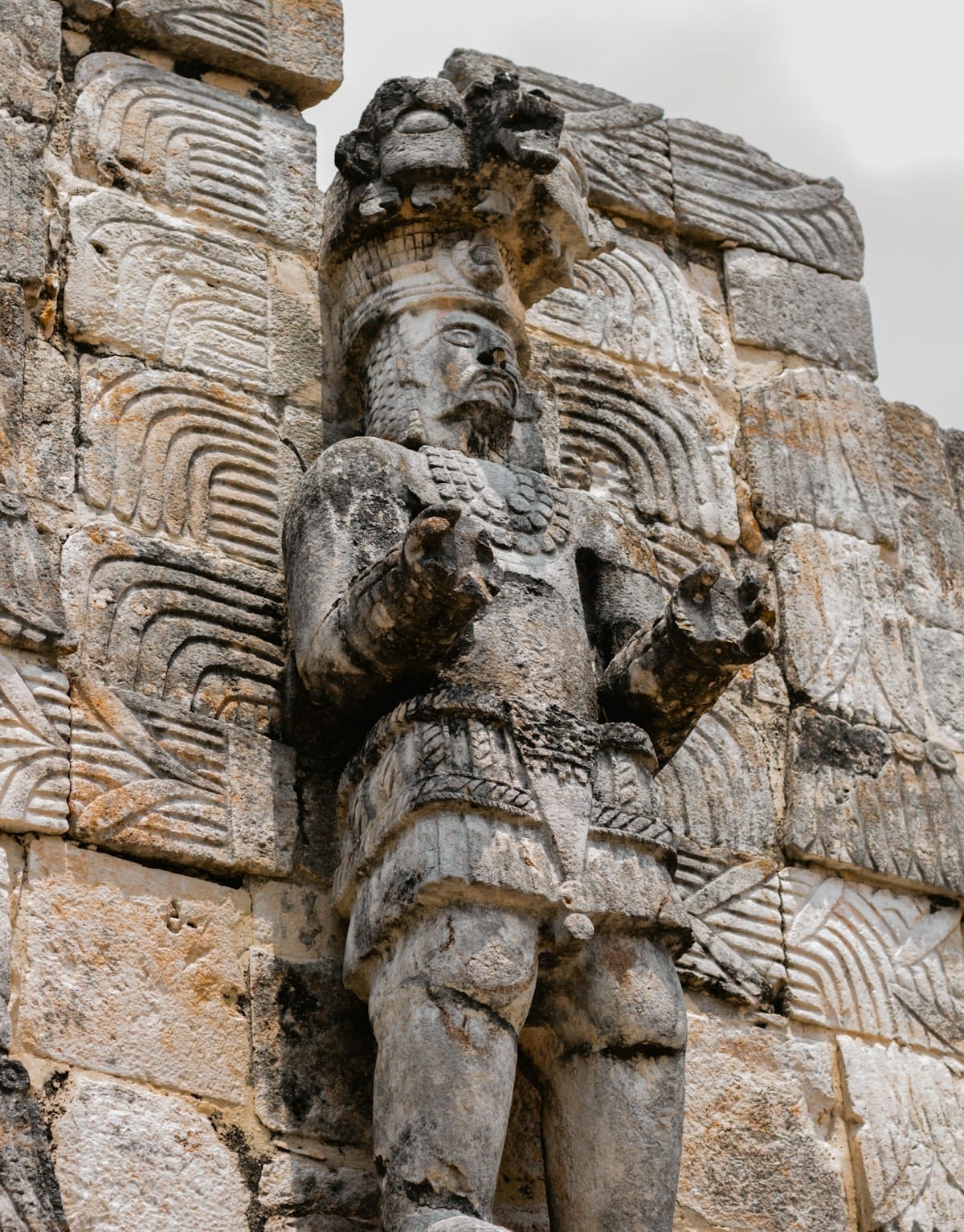
Uxmal is one of the most architecturally refined Mayan sites in Mexico - and consistently undervisited compared to Chichén Itzá, which makes it more rewarding for those who make the trip. The site represents the peak of Puuc-style architecture: highly geometric stone mosaic friezes, decorative masks of Chaac (the rain god), and a precision in construction that predates European Gothic cathedrals by several centuries. Where Chichén Itzá impresses with scale, Uxmal impresses with craftsmanship.
Background
Uxmal (pronounced “oosh-MAHL,” meaning “thrice built” in Yucatec Maya) flourished from approximately 700–900 CE and may have had a population of over 25,000 at its peak. The city was the dominant power in the Puuc hills region - a low limestone ridge in southern Yucatán - during the Terminal Classic period. Uxmal’s political alliances extended to nearby Kabah and Labná (both accessible on the Ruta Puuc circuit), and the sacbé (raised limestone road) connecting Uxmal to Kabah survives in part.
Unlike many Maya sites, Uxmal lacks cenotes - the city depended entirely on cisterns (chultuns) for water storage, which is why Chaac rain god iconography dominates the decorative programme. The anxiety about water is literally carved into every major facade. Over 100 Chaac masks have been identified across the site’s buildings.
The site was inscribed as a UNESCO World Heritage Site in 1996 and is managed by INAH (Mexico’s National Institute of Anthropology and History).
Key structures
Pirámide del Adivino (Pyramid of the Magician)
The most distinctive structure at Uxmal and the first building visitors encounter. Unusual for its oval or elliptical base - most Mesoamerican pyramids have rectangular bases. The pyramid rises approximately 35 metres and consists of five construction phases stacked on top of each other; X-ray excavations have revealed earlier buildings inside the current structure.
The name comes from a legend that the pyramid was built overnight by a dwarf magician - historically false, as the archaeological sequence spans several centuries. The western face has a staircase leading to a temple at the top with a Chenes-style decorative doorway (a monster-mouth mask framing the entrance). The eastern staircase is steeper and narrower. Climbing is no longer permitted as of recent years - check current access rules on arrival.
The pyramid is most photogenic in the morning light (the eastern face catches the sun first) and from the Nunnery Quadrangle courtyard, which frames it dramatically.
Cuadrángulo de las Monjas (Nunnery Quadrangle)
Despite the name (applied by Spanish colonisers who thought the 74 rooms resembled a convent), this was almost certainly a palace complex - possibly for high-ranking officials, a school, or a governmental building. Four palaces arranged around a central courtyard, each with an elaborate upper frieze:
- North Palace: the most complex decoration - rows of Chaac masks stacked vertically, geometric lattice patterns (representing thatched hut roofs in stone), and serpent imagery. This is the tallest of the four buildings and the most elaborately carved structure at Uxmal
- East Palace: features trapezoidal doorways and astronomical motifs, including owls (associated with the underworld)
- South Palace: the lowest building, with simpler decoration but a striking series of hut motifs along the upper facade
- West Palace: features intertwined serpent designs and seated figures within the serpent bodies - the most narratively complex facade
The courtyard itself is worth pausing in - the proportions and the interplay of light and shadow across the facades change throughout the day.
Palacio del Gobernador (Governor’s Palace)
Considered by many archaeologists to be the finest single building in pre-Columbian Mesoamerica. The structure sits on a raised platform and measures approximately 100 metres long, with an extraordinary mosaic frieze composed of over 20,000 individually carved and fitted stones. The frieze runs the entire length of the building and includes Chaac masks, serpents, lattice patterns, and human figures.
The central doorway is aligned with the southernmost point of Venus’s rising on the horizon - an intentional astronomical orientation demonstrating Maya astronomical sophistication. A jaguar throne (two-headed jaguar sculpture) sits in front of the palace, though it is heavily weathered.
The terrace in front of the Governor’s Palace offers the best panoramic view of the entire site - the Pyramid of the Magician, the Nunnery Quadrangle, and the surrounding jungle canopy are all visible from here.
Gran Pirámide (Great Pyramid)
Standing approximately 32 metres high, the Gran Pirámide offers the best elevated view across the entire archaeological zone. The summit temple retains partially carved decoration including macaw motifs. The climb is steep and the steps are narrow - bring water and take your time. From the top, the relationship between Uxmal’s buildings and the surrounding Puuc hills becomes clear.
El Palomar (the Dovecote)
Named for its latticed roof comb pierced with triangular holes that resemble pigeonholes. The roof comb is the best-preserved example of this architectural feature at any Puuc site. The building’s original function is unknown - it may have been a residential palace or an administrative building. The roof comb would originally have been covered in stucco and painted.
Casa de las Tortugas (House of the Turtles)
A smaller building near the Governor’s Palace, notable for its clean proportions and a cornice decorated with carved turtles. In Maya cosmology, turtles were associated with rain - consistent with the site’s obsession with water. The simplicity and elegance of this building contrasts with the more elaborately decorated structures.
The Ruta Puuc circuit
Uxmal is the anchor of the Ruta Puuc - a series of smaller Puuc-style sites in the surrounding hills. Combining Uxmal with one or two of these gives a deeper understanding of the regional architectural tradition:
| Site | Distance from Uxmal | Key feature | Entry fee |
|---|---|---|---|
| Kabah | 23 km (20 min) | Codz Poop - facade covered entirely with Chaac masks | ~MXN $75 |
| Sayil | 30 km (30 min) | Three-storey Gran Palacio, one of the largest Maya residential buildings | ~MXN $60 |
| Labná | 38 km (35 min) | Arch of Labná - the finest decorative arch in Maya architecture | ~MXN $60 |
| Xlapak | 33 km (30 min) | Small but well-preserved, quiet, rarely visited | ~MXN $60 |
Organised Ruta Puuc tours from Mérida (approximately MXN $800–1,500 per person) typically visit Uxmal + Kabah + one or two additional sites. Self-driving allows more flexibility - all sites are on a paved road south of Uxmal.
Practical information
Entry fee: Approximately MXN $500 as of 2026 (combined federal + state fee). This includes access to the evening sound-and-light show. Cash and cards accepted at the entrance.
Opening hours: 8 am–5 pm daily. Last entry at 4:30 pm.
Sound and light show: Held at approximately 7–8 pm (schedule varies seasonally - check at the entrance or with your hotel). The show projects coloured light onto the Pyramid of the Magician and the Nunnery Quadrangle while narrating Maya history. Available in Spanish (daily) and sometimes English (check schedule). Included in the entrance fee.
Getting there from Mérida:
- By bus: ATS Sur buses from the CAME terminal (Calle 70 between 69 and 71) depart at approximately 8 am daily (confirm schedule). Journey approximately 1 hour 15 minutes. Return buses depart from the site in the mid-afternoon (approximately 2:30–3 pm). Cost approximately MXN $100–150 each way. The bus schedule is limited - confirm return times on arrival
- By organised tour: Mérida agencies run day trips combining Uxmal with Kabah and sometimes Cenote Hacienda Ochil. Cost approximately MXN $800–1,500 per person including transport, guide, and entrance fees
- By rental car: the most flexible option. Highway 261 south from Mérida, approximately 80 km (1 hour 15 minutes). Free parking at the site. Allows you to combine Uxmal with the Ruta Puuc sites at your own pace
Best time to visit: Arrive at 8 am opening for cooler temperatures and fewer tour buses. The site faces broadly southwest and receives direct sun by mid-morning. By 11 am the heat can be intense (temperatures regularly exceed 35°C). Shade is limited to the interiors of some structures.
What to bring: Hat, sunscreen, at least 1.5 litres of water per person, comfortable shoes with grip (some structures involve climbing on uneven stone). Insect repellent is useful - the surrounding jungle harbours mosquitoes, particularly during the rainy season.
Facilities: A restaurant and gift shop are located at the entrance. Cold drinks and snacks are available. There is no shade or food inside the archaeological zone itself.
Time needed: 2.5–3.5 hours for a thorough visit of all major structures. Add 30–45 minutes if staying for the sound-and-light show. If combining with Kabah, plan a full day.
Guides: Licensed guides are available at the entrance for approximately MXN $800–1,200 per group. The Puuc architectural details reward expert explanation - a guide is particularly valuable here if you want to understand the iconography of the friezes.
Plan your trip: tours in Mérida.
Related City Guides
- Mérida Travel Guide
- Things to Do in Mérida - how Uxmal fits into a Mérida stay
- Day Trips from Mérida - Uxmal, Chichén Itzá, and other Yucatán archaeological sites
- Campeche Travel Guide - 2.5 hours west, with the Edzná ruins and the walled colonial city
Search hotels in Mexico on Booking.com
- 10 Days in the Yucatán - a Yucatán circuit placing Uxmal alongside Mérida and the Riviera Maya