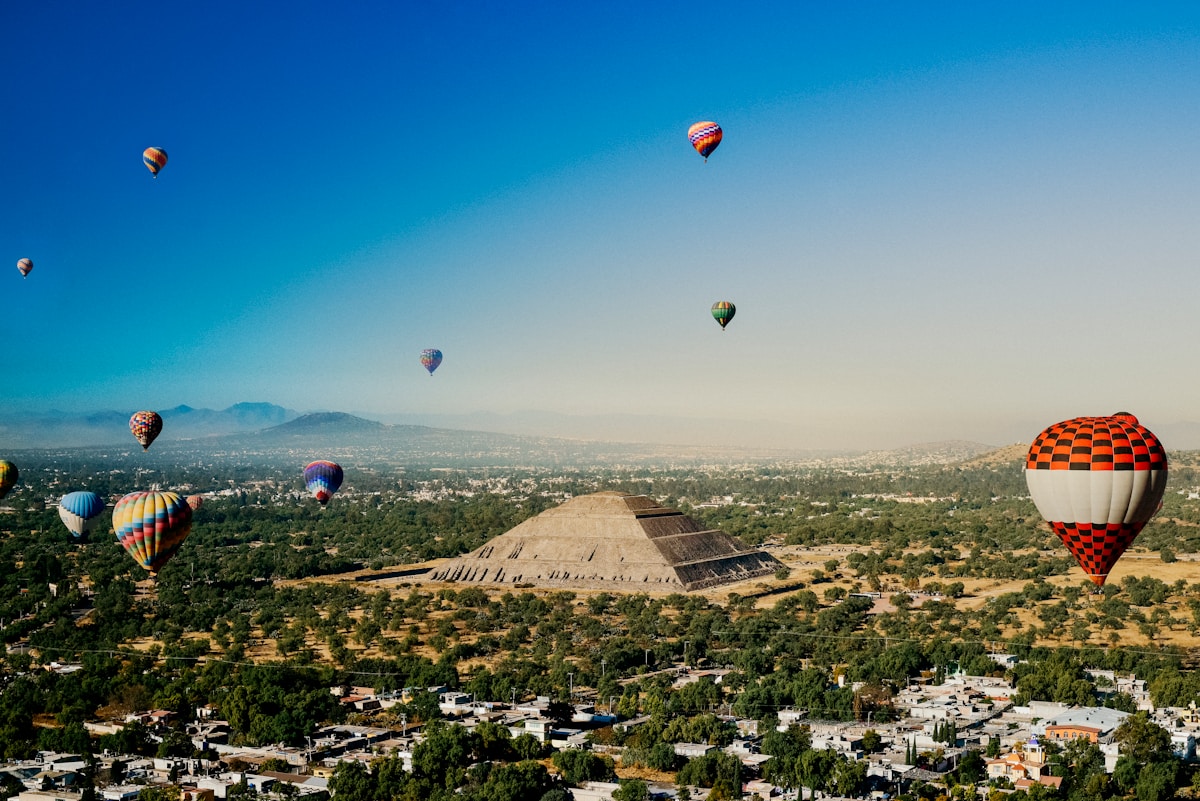
Teotihuacán was the largest city in the pre-Columbian Americas at its peak (approximately 100–550 CE), with an estimated population of 100,000–200,000 people - larger than contemporary Rome at certain points. The question of who built it remains unanswered: the Aztecs, who arrived 700 years after its collapse, called it “the place where the gods were created.” They were as uncertain about its builders as we are. The site is a UNESCO World Heritage Site (inscribed 1987) and the most visited archaeological zone in Mexico, receiving approximately 2.5 million visitors annually.
History
The city was founded around 100 BCE in the Valley of Mexico, approximately 50 km northeast of present-day Mexico City. It grew rapidly and by 100 CE was already the dominant urban centre in Mesoamerica.
The rise (100 BCE – 300 CE): Teotihuacán’s growth coincided with the eruption of the Xitle volcano (which destroyed the previous regional centre of Cuicuilco) and mass migration into the valley. The city was planned on a grid system - one of the earliest urban grid layouts in the world. The Pyramid of the Sun was built during this period, as was the Avenue of the Dead.
The peak (300–550 CE): At its height, the city covered over 20 square kilometres with more than 2,000 residential compounds. It controlled trade networks stretching from the Gulf of Mexico to the Pacific Coast and deep into the Maya lowlands. Teotihuacán-style architecture and pottery have been found at Tikal (Guatemala), Copán (Honduras), Monte Albán (Oaxaca), and Kaminaljuyú (Guatemala City). The cultural influence was Mesoamerica-wide.
The collapse (approximately 550 CE): A catastrophic event - almost certainly an internal revolt - resulted in the deliberate burning of the city’s elite religious and administrative structures. Importantly, residential compounds were largely spared, suggesting this was a targeted destruction of the ruling class rather than an external invasion. The city subsequently declined over the following centuries.
The identity question: The builders of Teotihuacán remain unknown. Recent DNA analysis suggests the population was ethnically diverse - including people from the Maya lowlands, the Gulf Coast, and Oaxaca. The dominant language is unidentified (no writing system has been fully deciphered). Some scholars have proposed Nahuatl, Totonac, or an Oto-Manguean language. The mystery is part of what makes the site compelling.
The site
The Avenue of the Dead (Calzada de los Muertos)
The central spine of the city - a 2.5-km processional avenue running roughly north-south (actually 15.5° east of true north, an alignment shared by the entire city grid). The name was given by the Aztecs, who misidentified the platforms along its length as tombs. They were actually temple platforms and administrative buildings. The avenue is approximately 40 metres wide and would have been plastered and painted - the original surface was polished red.
Walking the full length from the Pyramid of the Moon to the Ciudadela takes approximately 45 minutes without stops. The scale becomes apparent only when walking it - this was one of the largest ceremonial avenues in the ancient world.
Pyramid of the Sun (Pirámide del Sol)
The dominant structure on the site and the third-largest pyramid in the world by volume (after the Great Pyramid of Cholula and the Great Pyramid of Giza). Dimensions: approximately 225 × 225 metres at the base, rising 65 metres. The pyramid was built in two phases over the first century CE, constructed over a natural cave (now sealed to visitors) that may have had ritual significance - caves were symbolically linked to creation and the underworld in Mesoamerican cosmology.
The staircase to the summit is 248 steps - steep, unrailed, and exposed to direct sun. The climb takes approximately 15–20 minutes at a moderate pace. The view from the top encompasses the entire city grid, the Avenue of the Dead, the Pyramid of the Moon, and the surrounding Valley of Mexico. This is one of the most significant views in Mexican archaeology.
Note: As of recent years, climbing the Pyramid of the Sun has been periodically restricted for conservation. Check current access rules before planning your visit - this information is available on the INAH website or at the entrance gates.
Pyramid of the Moon (Pirámide de la Luna)
At the northern terminus of the Avenue of the Dead. Smaller than the Pyramid of the Sun (approximately 43 metres high) but positioned to frame the mountain Cerro Gordo directly behind it - this alignment is deliberate and creates a visual continuity between architecture and landscape that is one of the most photographed views in Mexico.
The summit is accessible by a staircase (visitors can climb to the fourth of five levels). From the top, the view back down the Avenue of the Dead toward the Pyramid of the Sun is the classic Teotihuacán photograph. Recent excavations beneath the pyramid have revealed sacrifice chambers containing the remains of humans, jaguars, wolves, eagles, and serpents - suggesting complex ritual activity.
Temple of Quetzalcóatl (Feathered Serpent Pyramid)
Located in the Ciudadela (Citadel) compound at the southern end of the Avenue of the Dead. The most ornately decorated building on site - the facade has alternating sculptured heads of the feathered serpent (Quetzalcóatl) and what are now thought to be rain deity or war deity faces. The original paint (red, green, blue, white) has largely faded, but some colour traces remain in sheltered areas.
Excavations beneath the pyramid uncovered approximately 200 sacrificial burials - warriors in military regalia, many bound, buried in symmetrical patterns around the structure’s perimeter. This discovery fundamentally changed understanding of Teotihuacán from a peaceful trade centre to a militaristic state.
Residential compounds and murals
The residential areas on the western edge of the main site preserve some of the finest pre-Columbian murals in Mexico:
- Tetitla: the most extensive murals, including the famous “Paradise of Tláloc” fresco showing the rain deity in a garden with butterflies and flowering trees. Remarkably well-preserved polychrome paintings
- Atetelco: murals depicting jaguars and coyotes in military attire - evidence of warrior orders similar to those later adopted by the Aztecs
- Tepantitla: home to the “Great Goddess” mural, one of the most debated images in Mesoamerican art
- Zacuala: residential palace with murals showing birds and floral motifs
These compounds are a 10–15 minute walk from the main avenue and are far less crowded than the pyramids. They are essential for understanding that Teotihuacán was a living city, not just a ceremonial centre.
Visiting practically
Entry fee: Approximately MXN $90 as of 2026. Additional fee for video cameras (approximately MXN $45). Tickets can be purchased at inah.gob.mx to avoid queues, though the online system is not always reliable.
Opening hours: 8 am–5 pm daily. Last entry at 4 pm.
Gates: The site has five entrance gates. Gate 1 (south, near the Ciudadela) and Gate 3 (west, near the residential compounds) are the most convenient for accessing the full site. Most bus services arrive at Gate 1.
Getting there from Mexico City:
- By bus: From the Terminal de Autobuses del Norte (Metro: Autobuses del Norte, Line 5). Buses marked “Pirámides” or “Los Pirámides de Teotihuacán” run by Autobuses Teotihuacán depart every 15–30 minutes from approximately 7 am. Journey approximately 1 hour. Cost approximately MXN $55–65 each way. Return buses depart from Gate 1 until approximately 6 pm - check the last return time on arrival
- By organised tour: Day trips from Mexico City hotels cost approximately MXN $800–2,000 per person depending on group size, guide quality, and inclusions. Tours that include a guide significantly improve the experience
- By car/taxi: approximately 50 km northeast via the Autopista México-Pachuca. Parking is available at all gates (approximately MXN $45). The drive takes 45–75 minutes depending on traffic - morning traffic leaving CDMX is lighter than the return
When to arrive: 8 am opening is strongly recommended. By 10–11 am the site is busy; by noon it reaches full tourist capacity with intense heat and minimal shade. A 2.5–3.5 hour visit starting at 8 am covers the main structures and at least one residential compound comfortably.
What to bring: Hat, sunscreen, at least 1 litre of water per person (vendors inside the site sell water at approximately MXN $25–40), comfortable shoes with grip (the surfaces are uneven volcanic rock), and snacks. There is almost no shade on the main avenue.
Vendors: Souvenir sellers line the Avenue of the Dead and can be persistent. A polite “no, gracias” is sufficient. Obsidian mirrors and carved figures are the most common offerings - quality varies enormously.
Hot air balloons
Several operators run balloon flights over the site at sunrise - the view of the pyramids emerging from the morning mist above the Avenue of the Dead is one of the most spectacular experiences in Mexico. Flights launch from fields adjacent to the archaeological zone and last approximately 45–60 minutes in the air, with 1–2 hours total for preparation and landing.
| Operator | Approximate cost | Notes |
|---|---|---|
| Volare Globos | MXN $3,500–4,500 per person | Includes breakfast, toast with sparkling wine |
| Globos Aerostáticos | MXN $3,000–4,000 per person | Various package options |
| Sky Balloons | MXN $3,500–5,000 per person | Larger baskets, group options |
Flights go year-round, weather permitting. Book at least 1–2 weeks in advance (further ahead during December–March peak season). Pickup from Mexico City hotels is typically available for an additional fee (approximately MXN $500–800). Flights launch at sunrise (approximately 6–7 am depending on season), which means a very early departure from CDMX.
Museo del Sitio (site museum)
Located near Gate 3, the Museo de la Cultura Teotihuacana houses artefacts from the excavations including obsidian tools, ceramic vessels, carved stone masks, and mural fragments. The museum provides essential context for the site - particularly the multi-ethnic nature of the population, the trade networks, and the ritual practices. Entry is included in the site ticket. Allow 45–60 minutes.
The museum also contains a scale model of the city at its peak, which helps visitors understand the full extent of the urban area - most of the residential zones are not accessible within the archaeological park.
Plan your trip: Teotihuacan tours · tours in Mexico City.
Related City Guides
- Mexico City Travel Guide
- Things to Do in Mexico City - other major CDMX attractions beyond Teotihuacán
- 3 Days in Mexico City - how to fit Teotihuacán into a short city break
- Mexico City Food Tours - guided food experiences to pair with your site visit
Search hotels in Mexico on Booking.com
- Oaxaca City Travel Guide - Mexico’s other major Zapotec site at Monte Albán