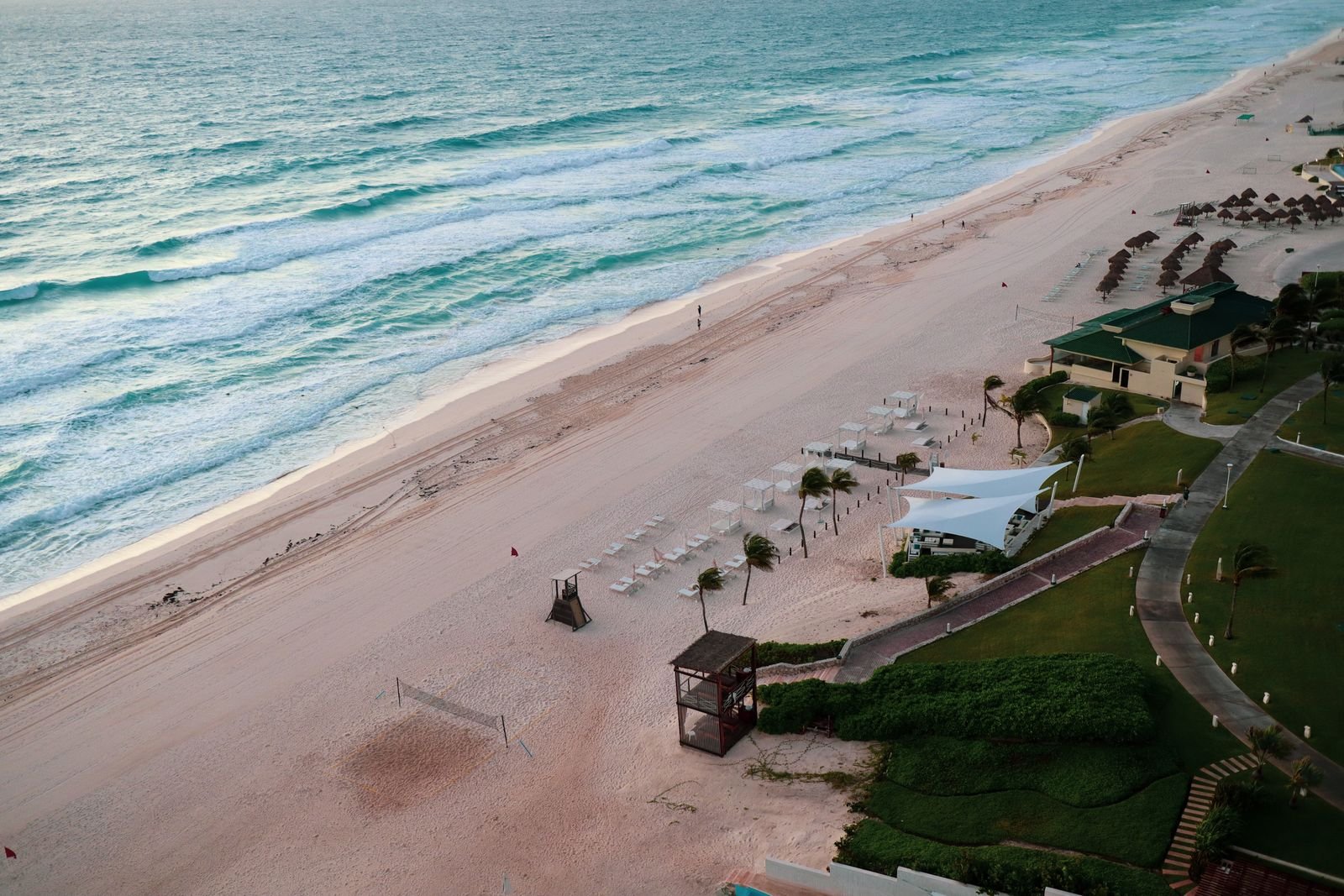
Cancun’s beaches are easy to find and easy to misjudge. The Zona Hotelera is a 22 km strip shaped like a number seven, and the two arms face different water: the short northern arm looks onto the sheltered Bahia de Mujeres, while the long southern arm faces the open Caribbean with bigger waves. Locating a beach by its kilometre marker on Boulevard Kukulcan tells you almost everything you need to know about whether it is calm. For the wider region see our Riviera Maya beach guide, and for everything else the Cancun city guide.
Calm beaches on the Bahia de Mujeres (Km 3-9)
Playa Las Perlas and Playa Langosta (Km 2-5)
The closest swimming beaches to downtown. Water is shallow, calm and usually clear, and there are public access paths between hotels. Good for children and nervous swimmers. They also see fewer waves, so sargassum can linger in bad weeks.
Playa Gaviota Azul and Playa Caracol (Km 3.5-9)
Sheltered, central, and close to bars and restaurants. Caracol is among the more consistent for small waves and clear water, with a mix of hotel frontage and public sand.
Playa Tortugas (Km 6.5)
A busy public beach with calm water, food stalls and a dock for water sports. It works well on a budget. Lifeguard coverage is more reliable here than at many other beaches, but crowds peak on weekends.
Open-sea beaches (Km 10-20)
Playa Marlin (Km 13.5)
Big, scenic, and more exposed. Check the flag before entering the water.
Playa Delfines (Km 18)
The most famous public beach in Cancun, with the colourful “CANCUN” sign, wide white sand, and few buildings behind it. It faces the open sea, so surf and currents can be strong. Go early for photos and swim only on a green or blue flag day. There is parking, basic facilities and food vendors, and the beach is free.
Flag colours and water quality
| Flag | Meaning |
|---|---|
| Blue or green | Normal conditions |
| Yellow | Caution, strong waves or currents |
| Red | Do not enter the water |
| Black | Beach closed |
The national health regulator publishes beach water results on the COFEPRIS site.
Sargassum
Seaweed is heaviest from May to September and varies sharply by year. Open-sea beaches and northern bay beaches can both be affected, while Isla Mujeres’ Playa Norte tends to stay cleaner. Use our sargassum season guide before booking, and consider Cancun in January if you want the clearest conditions. For monthly weather see best time to visit Cancun.
How to choose a beach by trip type
Families with young children do best on the calm northern arm, at Playa Tortugas or Playa Langosta, where lifeguard coverage is more reliable and the water is shallow. Couples after the photo-friendly wide beach should aim for Delfines at sunrise and swim only on a green or blue flag day. Budget travellers can use public access paths and bring their own water and snacks, since many Zona Hotelera beach clubs charge a minimum spend for loungers. Groups wanting watersports will find the most choice around Playa Tortugas and the lagoon-side docks. Buses (the R1 and R2 routes along Kukulcan Boulevard) cost only a few pesos and are the cheapest way to hop between beach markers, with the exact fare shown on the bus (as of 2026). If you are staying in downtown Cancun, the public bus makes day beach trips easy without renting a car.
Easy beach upgrades
- Isla Mujeres: A short ferry from Puerto Juarez, approximately MXN $300 return (as of 2026). See our Isla Mujeres guide.
- Snorkel and catamaran trips: Cancun tours include reef stops and sheltered coves.
- Day trips south: Tulum and Akumal are about 1.5 hours away; see best beaches in Tulum.
Where to stay
For calm water, pick a hotel on the Bahia side or on a protected stretch. For all-inclusives and strip resorts see Cancun hotels and our all-inclusive Cancun guide, or search Cancun stays on Booking.com. Hostel dorms are on Hostelworld. If you are flying in, read the Cancun airport transfer guide.
Plan your trip: Cancun tours · Cancun hotels · travel insurance.