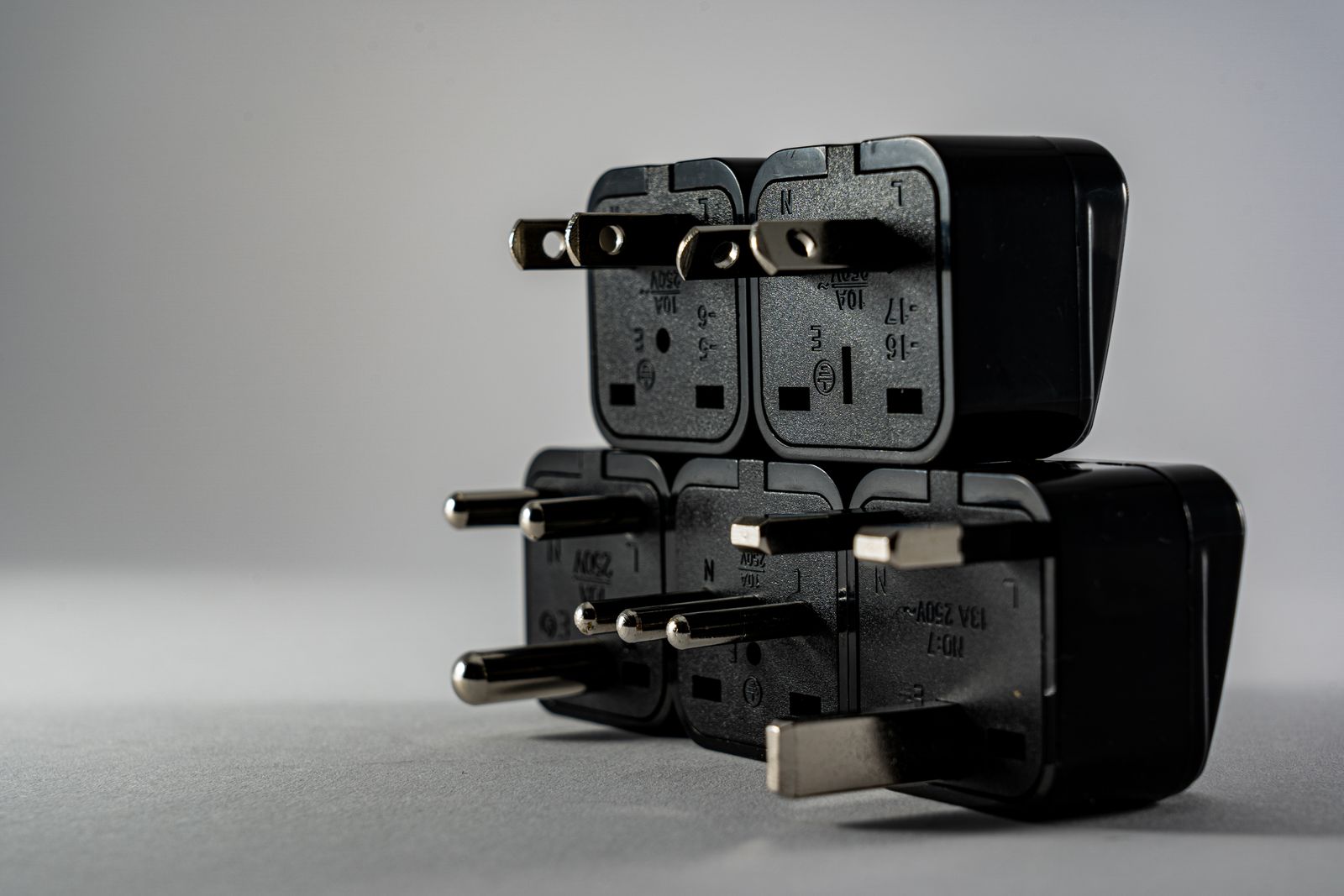
Mexico uses the same electrical system as the United States and Canada: Type A and Type B plugs, around 127V, 60Hz. If you are coming from the US or Canada you can almost certainly plug in and go. If you are coming from the UK, Europe, Australia or most of Asia, you need a plug adapter and a quick check of each device’s voltage label. This page covers the details, plus the practical quirks of Mexican wiring that catch visitors out. Figures are accurate as of 2026.
Plug types in Mexico
| Type | Description | Where you will see it |
|---|---|---|
| Type A | Two flat parallel pins, no earth | Older buildings, budget hostels, ungrounded outlets |
| Type B | Two flat pins plus a round earth pin | Newer hotels, resorts, Airbnbs, modern apartments |
A Type A plug fits both outlets. A Type B plug only fits grounded sockets. That matters because many older hotels in Oaxaca, Mérida, Guanajuato and Mexico City’s historic centre still have two-slot outlets. Laptop chargers with three prongs will not fit without a ground-lift adapter, which costs around MXN 30 to 60 at a ferretería (hardware store).
Voltage and frequency
Mexico’s nominal supply is 127V at 60Hz. That is slightly above the 120V standard in the US, but within the tolerance of any device built for North America. Voltage can fluctuate, particularly in smaller towns, on the Yucatán coast and during storms in hurricane season.
The rule is simple. Look at the small print on the charger or power brick:
- Input 100-240V, 50/60Hz: works anywhere. This covers nearly all phones, tablets, laptops, cameras, e-readers, power banks and many electric toothbrushes. You need only a plug adapter.
- Input 120V only: fine for visitors from North America.
- Input 220-240V only: not suitable. Plugged into 127V, it will run weakly or not at all. You would need a step-up transformer, which is heavy and rarely worth carrying.
Frequency is rarely an issue for modern electronics, but 50Hz-only motor devices such as some older clocks and turntables may run slow on 60Hz.
Which adapter to bring
- From the UK, Ireland, Malta or Cyprus: a UK to Type A/B adapter.
- From continental Europe: a Type C/F to Type A/B adapter. Make sure it is a real two-flat-pin design, not a UK-style one.
- From Australia and New Zealand: a Type I to Type A/B adapter.
- From the US and Canada: nothing, though a three-to-two prong adapter is a useful backup.
- From Asia and elsewhere: a universal travel adapter with a USA setting covers almost everything.
A universal adapter with built-in USB-A and USB-C ports is the most practical single item. Buy it before you travel for the best choice. In Mexico, electronics shops such as Steren, which has branches in most large cities, and big stores like Liverpool, Walmart de México and Costco stock adapters, extension cords and power strips at reasonable prices.
Charging in practice
- Outlet quality varies. Loose sockets that let plugs fall out are common in older properties. A short extension cord or power strip helps, and a heavier adapter can sag out of a worn socket.
- Surge protection is worth having for laptops on the Pacific and Caribbean coasts during hurricane season, from June to November. Afternoon storms can cause brief outages. See our Mexico hurricane season guide for timing.
- USB ports are increasingly built into bedside lamps and outlets in modern hotels, but do not rely on them. Bring your own charger.
- Power banks are essential on long bus rides and day trips to Chichén Itzá, Teotihuacán and the Copper Canyon, where outlets are scarce. Airlines require power banks in carry-on only.
- Coworking spaces and cafés in Mexico City’s Roma and Condesa, Playa del Carmen and Mérida typically have outlets at most tables, which is useful for remote workers.
Hair dryers, straighteners and other heating appliances
High-wattage heating items are where voltage mistakes happen. A 220-240V European hair dryer plugged into a 127V socket will run at roughly half power. A dual-voltage travel dryer works if you set the switch to 120V. Because nearly every hotel and many rentals supply a dryer, we suggest leaving yours behind. Our packing guide for Mexico lists what is genuinely worth the luggage space.
For a kettle or travel iron, buy a cheap local one if you are staying long term. Mexican households generally use gas stoves and stovetop kettles, so electric kettles are less universal than in the UK.
Staying connected as well as charged
Power is only half of the equation. Pair your adapter with a data plan before you land: our eSIM guide for Mexico compares options, or you can get an eSIM for Mexico in advance. Travelling with expensive electronics also makes cover worthwhile, so see travel insurance for Mexico and our health in Mexico guide for medical basics.
Quick checklist
- Check every charger label for 100-240V.
- Pack one universal adapter or a Type A/B adapter per traveller who shares sockets.
- Add a three-to-two prong adapter if you have grounded plugs.
- Bring a compact power strip for hostel dorms and shared rooms.
- Leave 220-240V-only appliances at home.
- Carry a power bank for long travel days.