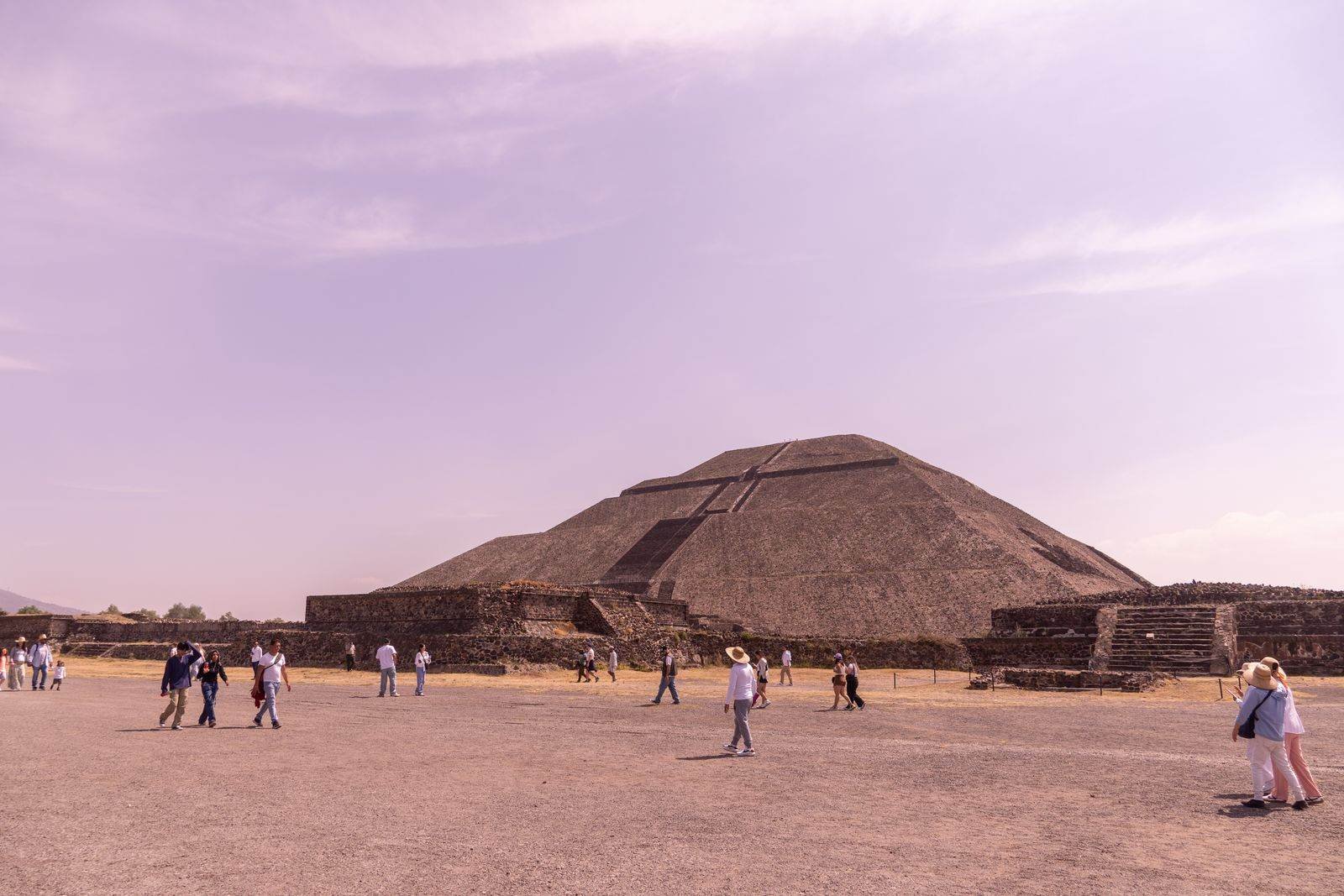
Mexico has more than three thousand years of recorded history before Spanish ships arrived. Cities were planned, calendars tracked the stars and trade networks stretched from the modern US Southwest to Central America. Knowing that past makes the murals, pyramids and plates of food easier to read. This page is a single-sitting overview; the site guides linked below go deeper.
The great pre-Hispanic civilisations
The Olmecs (about 1500-400 BCE)
Based on the Gulf coast in today’s Veracruz and Tabasco, the Olmecs are widely treated as Mesoamerica’s first major civilisation. Their basalt colossal heads, some over three metres tall, are the best-known image of their art. Ideas associated with them, including early writing and calendar systems, the feathered serpent and the ritual ball game, reappear in later cultures.
Teotihuacan (about 100-700 CE)
About 50 km north-east of Mexico City, Teotihuacan was among the largest cities in the world at its height, with an estimated 125,000 to 200,000 residents. Its builders, whose ethnic identity archaeologists still debate, raised the Pyramid of the Sun and Pyramid of the Moon along a ceremonial avenue several kilometres long. The city declined around 700 CE, and the Aztecs later treated its ruins as sacred. Read our Teotihuacan guide, or see the valley at dawn from a hot air balloon.
The Maya (Classic period, about 250-900 CE)
The Maya were a network of independent city-states sharing language, script and cosmology, not a single empire. Cities such as Palenque, Uxmal and Chichen Itza show their mathematics (including an independently developed zero), precise astronomy and a hieroglyphic script that is now largely deciphered. Chichen Itza was named one of the New Seven Wonders in 2007, and at the spring and autumn equinoxes light and shadow produce a serpent-like effect on El Castillo’s stairway. Entry is roughly 570-600 MXN for foreign visitors (as of 2026, check before travel). See our guides to Chichen Itza, Palenque, Uxmal and Mexico’s best Maya ruins.
The Aztecs, or Mexica (1325-1521)
The Mexica arrived in the Valley of Mexico in the 13th century as a migrating people. According to their own tradition, a sign from the god Huitzilopochtli, an eagle on a cactus eating a serpent, marked where to settle, and that image is on Mexico’s flag today. They founded Tenochtitlan on an island in Lake Texcoco in 1325. Within two centuries they commanded the largest empire in Mesoamerican history, collecting tribute from hundreds of subject towns. By 1500 Tenochtitlan held perhaps 200,000 people, larger than most European capitals, with causeways, aqueducts, markets, chinampa gardens and the Templo Mayor at its centre. The Templo Mayor ruins sit beside Mexico City’s Zocalo; see our Mexico City guide.
The Spanish conquest (1519-1521)
Hernan Cortes landed near present-day Veracruz in 1519 with roughly 500 soldiers, 16 horses and 11 ships. Within about two years the Aztec empire had fallen. Historians cite several causes:
- Epidemics, mainly smallpox and measles, to which the indigenous population had no immunity
- Indigenous allies, above all the Tlaxcalans, historic enemies of the Mexica, who supplied thousands of fighters
- Tension inside the empire, as subject peoples saw a chance to escape tribute
La Malinche (Malintzin), Cortes’s interpreter and adviser, remains one of the most debated figures in Mexican memory, seen by some as a traitor and by others as a survivor in impossible circumstances. Tenochtitlan fell in August 1521.
New Spain (1521-1821)
For three centuries Mexico was New Spain, the richest colony of the Spanish crown. Silver from Zacatecas, Guanajuato and San Luis Potosi funded Spain and flowed to Europe in huge volumes. The colonial cities you can still walk, including Guanajuato, San Miguel de Allende, Morelia, Puebla and Oaxaca, were built on that wealth. See our Guanajuato and Puebla guides.
Spanish, indigenous and African populations (enslaved Africans were brought to work on haciendas and in mines) produced the mestizo society that defines modern Mexican identity. The Church was central: Franciscan, Dominican and Jesuit missions spread Catholicism and Spanish, often building churches directly over indigenous temples.
Independence (1810-1821)
On 16 September 1810 the priest Miguel Hidalgo rang the church bell in Dolores, Guanajuato, and called for revolt, the Grito de Dolores. Each year the president repeats the cry from the balcony of the National Palace. The war lasted eleven years and was brutal. Hidalgo was executed in 1811, Jose Maria Morelos carried on the struggle, and Agustin de Iturbide declared independence in 1821. The new country had heavy debts, unresolved regional rivalries and no experience of self-government.
The 19th century: instability and invasion
The first decades were turbulent: dozens of presidents, a short-lived monarchy and two foreign invasions. The war with the United States (1846-1848) cost Mexico more than half its territory, including present-day California, Nevada, Utah, Arizona and most of New Mexico and Texas.
France invaded in 1862 and installed Maximilian of Habsburg as emperor. The republic, led by Benito Juarez, defeated the empire, and Maximilian was executed in 1867. Juarez remains the only indigenous president Mexico has had. The long rule of Porfirio Diaz (1876-1911), the Porfiriato, brought railways and foreign investment but concentrated land and wealth in few hands.
The Mexican Revolution (1910-1920)
The Revolution began when Francisco Madero challenged Diaz and became a multi-sided civil war. Emiliano Zapata fought in the south for land reform under the slogan “Tierra y Libertad”, and Pancho Villa led the Division del Norte in the north. Estimates of the dead run from one to two million. Its most lasting product was the Constitution of 1917, still in force with amendments, which established labour rights, secular public education and land reform.
Modern Mexico
The PRI governed continuously from 1929 to 2000. Between the 1950s and 1970s the economy grew quickly in what is often called the Mexican Miracle. The 1982 debt crisis and the 1985 Mexico City earthquake, which exposed a weak state response, accelerated democratisation, and in 2000 Vicente Fox ended 71 years of PRI presidencies. Today Mexico is one of the largest economies in Latin America, with sharp contrasts between regions. The past is visible in every mural, ruin and menu.
Sites for understanding Mexican history
| Site | State | Culture | Approx. entry (2026) |
|---|---|---|---|
| Teotihuacan | State of Mexico | Unknown builders | 90-100 MXN |
| Chichen Itza | Yucatan | Maya, with later influences | 570-600 MXN |
| Monte Alban | Oaxaca | Zapotec | 90-100 MXN |
| Palenque | Chiapas | Classic Maya | 90 MXN |
| Templo Mayor | Mexico City | Aztec | 90 MXN |
| Uxmal | Yucatan | Maya (Puuc style) | 570-600 MXN |
Prices are approximate and change; confirm with INAH, Mexico’s national institute of anthropology and history, at inah.gob.mx. Also see the Monte Alban guide and UNESCO’s World Heritage listing for Mexico.
To visit these places with a guide, browse tours across Mexico, add flights and travel insurance, or read our wider overview of things to do in Mexico.
To see the Aztec, colonial and republican layers in one city, read our guide to 5 historical sites in Mexico City.